
Aunt Fern's Tall Tales
One women invented three origin stories for our family. I spent a decade debunking those stories. She got the last laugh.

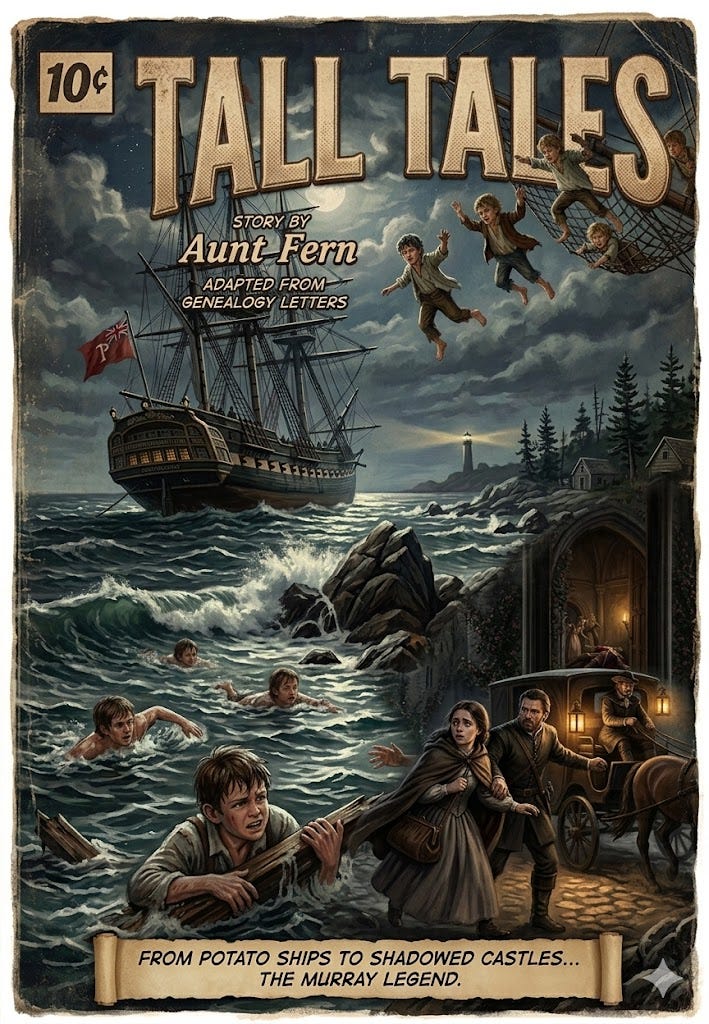
Every family has a story that doesn’t quite hold up under cross-examination. Maybe it’s a great-grandfather who “knew Lincoln” or a cousin who was “almost famous.” You nod along at Thanksgiving, you let it ride, and you move on to the pie.
My family had many such stories. And they all came from the same woman.
Aunt Fern was my grandmother Sylvia Murray’s sister. She was not a historian. She was not a genealogist. She was something far more interesting: she was a good storyteller with a captive audience and absolutely no interest in the historical record. Over the course of her life, she constructed three blockbuster origin stories for the Murray family, each one more spectacular than the last, and passed them along with the confidence of someone reading from a leather-bound family Bible.
Aunt Fern’s tales didn’t die with her. They were faithfully transmitted to the next generation by her sister, my great-aunt Margaret—who wrote them down in a series of letters to my father, Jim, in the 1990s. On Hummel stationery, no less. If you’re going to commit family mythology to paper, you might as well do it next to a watercolor of German schoolchildren.
I know all of this because after my father died in 2012, I found the letters. And after I found the letters, I spent the better part of a decade doing the one thing Aunt Fern never intended anyone to do: checking.
* * *
Tale #1: The Prison Ship
In January 1993, Aunt Margaret wrote to my father on a Hummel notecard. The letter opens with a burst of enthusiasm:
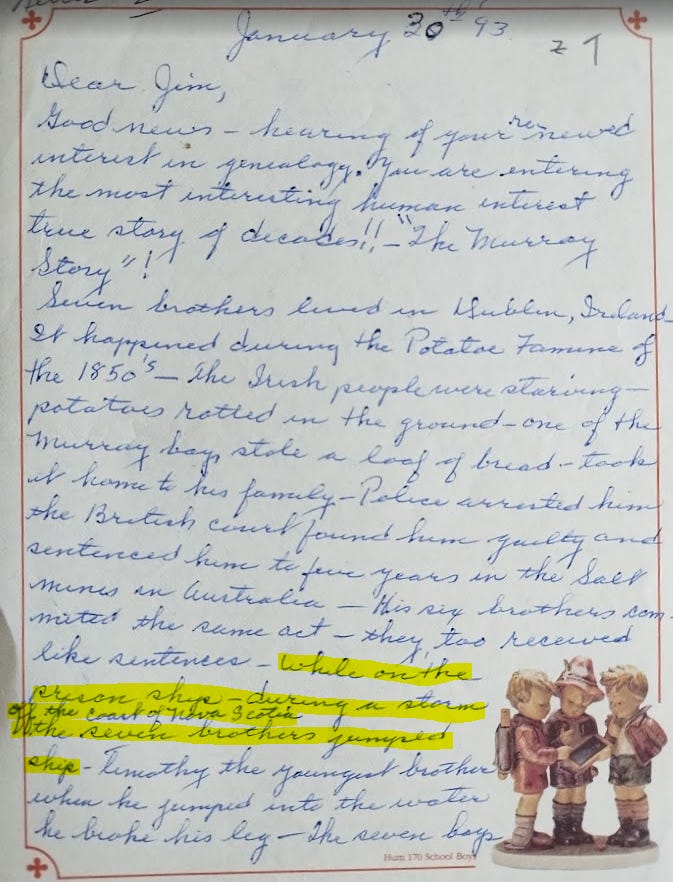
Good news — hearing of your renewed interest in genealogy. You are entering the most interesting human interest true story of decades!! — “The Murray Story”!
Two exclamation marks and quotes around “The Murray Story” as though it were a feature film in development. Which, in Aunt Fern’s imagination, it essentially was.
Here’s the tale as Margaret relayed it: Seven brothers lived in Dublin, Ireland. During the Potato Famine of the 1850s, one of the Murray boys stole a loaf of bread. The British court found him guilty and sentenced him to five years in the salt mines of Australia. His six brothers committed the same act and received the same sentence. While on the prison ship, during a storm off the coast of Nova Scotia, the seven brothers jumped ship. Timothy, the youngest, broke his leg when he hit the water. The boys were befriended by a Nova Scotian family. Timothy’s leg was amputated. From Nova Scotia, they migrated to Canada.
It’s a blockbuster. Seven brothers, a stolen loaf, a daring escape in a storm, an amputation, a kind stranger. It has everything except evidence.
This story was so embedded in the family that when I sat down to write my biography of James A. Murray—Fern’s uncle, a Gilded Age copper king who amassed a fortune equivalent to $3 billion in today’s money—I opened the book with it. I gave it a full cinematic treatment: the mud hut in County Clare, the boys getting intentionally arrested so they’d be together on the prison ship, little Jimmy Murray spotting a red-haired Irish woman on the Nova Scotia coast who would save them. I let the tale unspool for several pages before pulling the curtain back.
Because it couldn’t be true. And I knew it couldn’t be true because records exist and I looked at the records.
The British Convict Transportation Registers from 1788 to 1868 contain no records of children under the age of ten being transported to Australia—let alone a group of brothers from a single family. There were seven Murray brothers, yes. But the eldest, James, was barely a teenager during the famine years, and the youngest were small children. The family escaped Ireland in 1849, but they did so the way millions of other desperate Irish families did: crammed into the hold of a British logging ship returning to Canada for another payload, using Irish peasants as ballast. Not as convicts on a prison barge. As cargo.
So why did Aunt Fern tell it this way? I think the answer is in what the story does that the truth doesn’t. A family stuffed into the hold of a lumber ship is a tragedy. Seven boys outsmarting the British Crown is a legend. As the Irish-American radical Elizabeth Gurley Flynn wrote in her autobiography, the awareness of being Irish “came to us as small children, through plaintive songs and heroic story.” The prison ship tale was one of those heroic stories. It turned the Murrays from refugees into rebels.
Aunt Fern was not making things up. She was doing something more interesting. She was making sure the Murrays mattered.
* * *
Tale #2: Robert E. Lee’s Secret Daughter
If the prison ship was Aunt Fern’s action movie, the second tale was her historical romance.
This one was about her paternal grandmother—the wife of prison ship jumper Daniel Murray. According to Aunt Fern, this woman was the secret daughter of Confederate general Robert E. Lee, exiled to Canada to avoid the Civil War.
Robert. E. Lee.
I’ll let that sit for a moment.
The general, according to Aunt Fern, had a secret Irish daughter who was spirited away to the Great White North and eventually married into a family of famine refugees in London, Ontario. If you’re scoring at home, our family tree now includes both a daring prison break from British tyranny and a direct bloodline to the commander of the Army of Northern Virginia. We are, by Aunt Fern’s reckoning, the most interesting family in the Western Hemisphere.
I can tell you that Robert E. Lee did not have a secret daughter in Ireland or Canada. But I can also tell you that Aunt Fern got the claim into her own obituary.
Here it is.
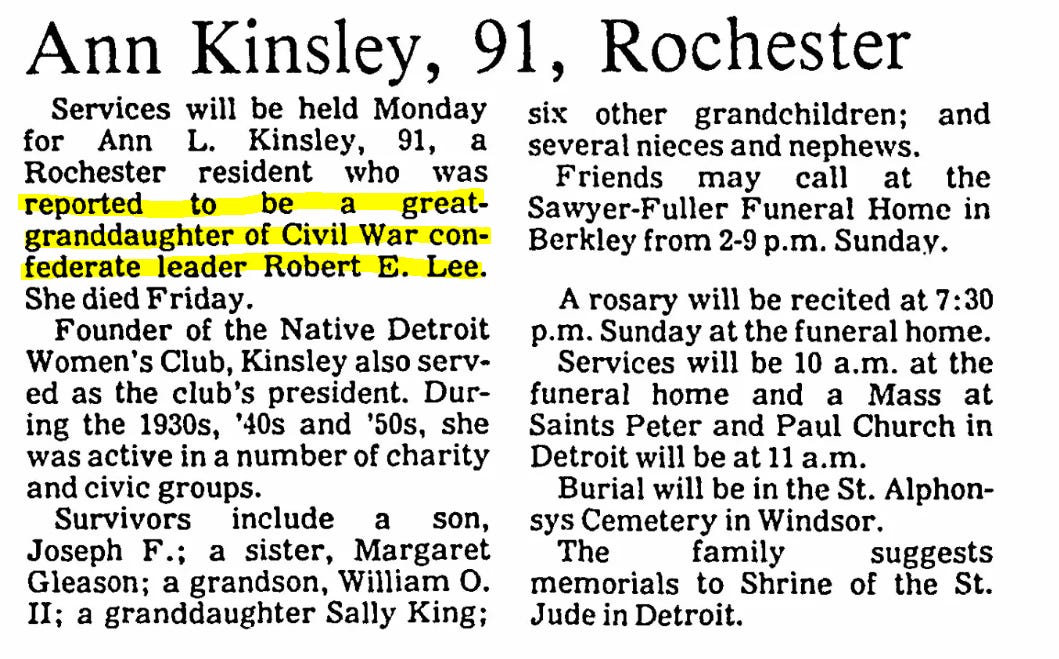
Ann L. Kinsley, 91, of Rochester, Michigan. The second sentence of her death notice in the Oakland Press reads: “a Rochester resident who was reported to be a great-granddaughter of Civil War confederate leader Robert E. Lee.” Ann was Fern. Her given name was Ann; Fern was the name the family knew her by. She died on a Friday in February 1987 at the age of ninety-one.
Notice the hedge: “was reported to be.” Someone at the newspaper, or someone at the funeral home, had just enough institutional caution to add those three words. But they still printed it. The Robert E. Lee claim made it past whatever editorial review exists for obituary copy in a Michigan newspaper in 1987 and entered the permanent record.
And notice the survivors: “a sister, Margaret Gleason.” That’s Aunt Margaret—the letter writer. She was alive when this obituary ran. She read it. She may have been the one who supplied the information to the funeral home in the first place.
I found this obituary years ago while doing genealogical research and filed it away as a curiosity—irrelevant to the serious historical work I was doing. I was thinking like a researcher, not a storyteller. It took me decades to understand that this clipping is the single best proof I have that Aunt Fern won. She got a tall tale into a published death notice. It survived her. Somewhere in a Michigan archive, the Oakland Press from February 28, 1987 records for posterity that the Murray family descends from Robert E. Lee. No footnote. No correction. Just Fern’s imagination, set in type.
* * *
Tale #3: The Rose Castle and the Murdered Royal
Aunt Fern didn’t stop with the paternal side. She gave the maternal grandmother her own legend, too.
In the June 1995 letter, Aunt Margaret—writing to my father before his trip to Ireland—relayed Fern’s account of this other grandmother, a woman from an entirely different branch of the family:
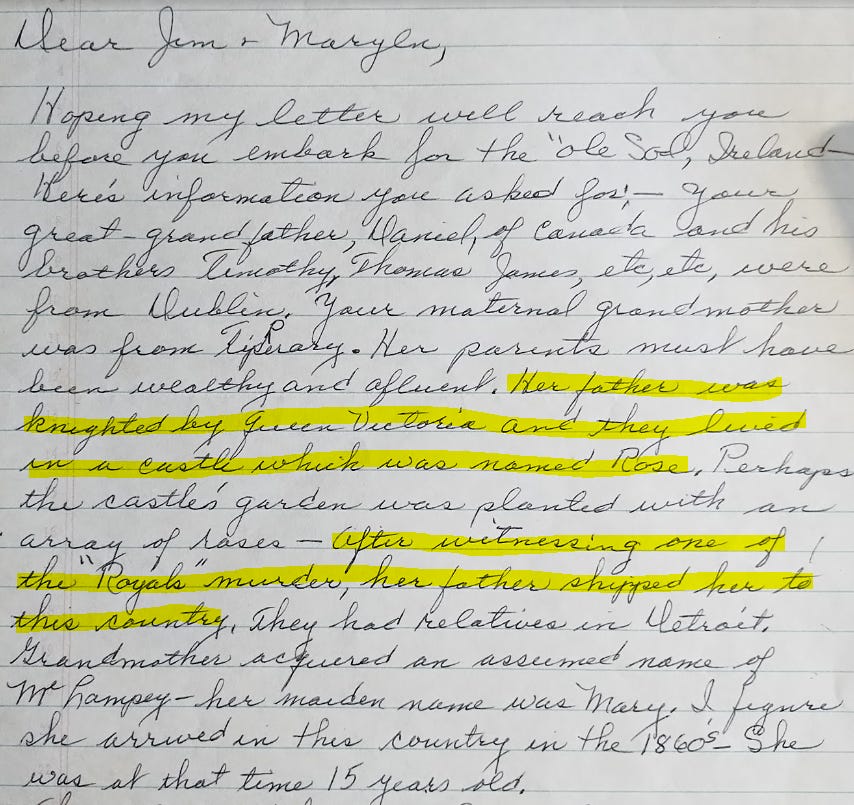
Hoping my letter will reach you before you embark for the ‘ole Sod,’ Ireland — Here’s information you asked for — Your maternal grandmother was from Tipperary. Her parents must have been wealthy and affluent. Her father was knighted by Queen Victoria and they lived in a castle which was named Rose. Perhaps the castle’s garden was planted with an array of roses.
A knighted Irish nobleman. A castle called Rose. A garden of roses. This is already operating at a level of specificity that should make any genealogist nervous. “Perhaps the castle’s garden was planted with an array of roses” is doing an enormous amount of work. But Aunt Fern was just getting started.
According to the tale, after this grandmother “witnessed one of the ‘Royals’ murder,” her father shipped her to America, where she had relatives in Detroit. She assumed the name McLampey—her maiden name was Mary—and arrived in the 1860s at about fifteen years old.
This is the most elaborate of the three tales, and also the hardest to debunk cleanly because it’s the vaguest. Which “Royal” was murdered? When? The details are just impressionistic enough to resist a direct fact-check while being vivid enough to feel true. That’s not an accident. Aunt Fern understood instinctively what every good fiction writer knows: specificity creates credibility, but too much specificity invites scrutiny. A castle named Rose is checkable. A grandmother who “witnessed” an unnamed murder is not.
And here’s what makes this tale the masterpiece of the set: it’s about a completely different grandmother than the Lee story. Aunt Fern gave the paternal grandmother a Confederate general for a father. She gave the maternal grandmother a castle, a knighted nobleman, and a murdered royal. Each side of the family got its own origin myth, tailored to its own geography and romance. The woman was thorough.
How thorough? Those three tales weren’t even the complete inventory. In a February 1977 letter—written in her own hand this time, not relayed through Margaret—Fern added two more. She was eighty-one years old, recovering from a broken hip, and still connecting the Murrays to American legends from her recovery bed.
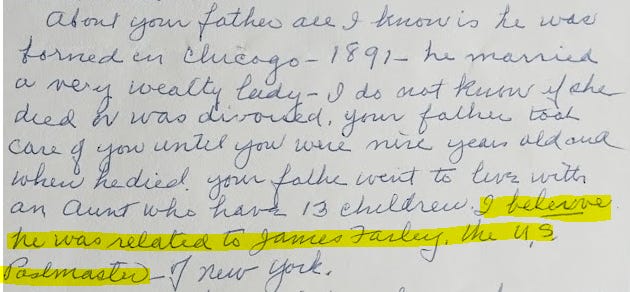
First, she reported that my father’s family “was related to James Farley, the U.S. Postmaster of New York.” James Farley was FDR’s Postmaster General and one of the most powerful political operatives in twentieth-century America. A useful relative, if true.
Then came this:
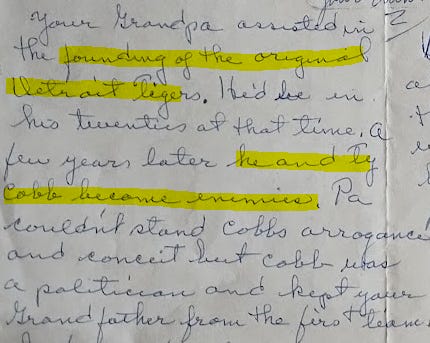
Your Grandpa assisted in the founding of the original Detroit Tigers. He’d be in his twenties at that time. A few years later he and Ty Cobb became enemies. Pa couldn’t stand Cobb’s arrogance and conceit but Cobb was a politician and kept your Grandfather from the first team.
The claim has all the hallmarks: just enough historical texture to feel plausible—Cobb really was legendarily arrogant—and just enough vagueness to resist a clean fact-check. Which grandfather? What years? “Kept your Grandfather from the first team” doing what, exactly? But the emotional logic is perfect: our family would have been famous, except a bully got in the way. It’s the Murray origin story in miniature. We mattered. Forces conspired against us. The record is wrong.
Once you see the pattern, you realize the three big tales weren’t isolated episodes. They were a worldview. Aunt Fern did this with everything. Every branch of the family tree got a legend. Every ancestor got promoted.
* * *
The Through-Line
Step back and look at the three blockbuster tales together. Each one elevates the Murray family from ordinary immigrants to people who mattered on the stage of history. The prison ship makes them freedom fighters. The Lee connection makes one grandmother Confederate aristocracy. The Rose Castle makes the other grandmother a witness to royal intrigue. Two grandmothers, two legends, and a prison break—none of it true, all of it magnificent.
And here’s what I find most interesting: the letters reveal that Aunt Fern wasn’t the only family mythmaker. In that same January 1993 letter, Aunt Margaret pivots from the prison ship tale to a piece of real family history—and gets it almost right:
Incidentally — Senator Murray of Montana was an attorney and he was a crook! He made Pa sign off papers which otherwise would make him well-to-do — He threatened Pa’s illegal stay in the country.
This one checks out, mostly. Senator James E. Murray did pressure William Murray—my great-grandfather, Margaret’s father—during the fight over James A. Murray’s estate in the 1920s. The senator and Mary Murray, James A.’s widow, did use threats, including the immigration status of relatives who hadn’t naturalized, to bully heirs into accepting lowball settlements. Margaret’s version compresses and simplifies, but the bones are real. She’d watched it happen to her own father. (I told that story in last week’s post.)
I mention it here because it shows you the spectrum. The same family that produced Aunt Fern’s fantasies also produced Aunt Margaret’s grudges—and the grudges turned out to be sourced.
* * *
What Tall Tales Are For
I spent years being mildly annoyed by Aunt Fern. When you’re trying to build a credible historical account—one that will hold up to peer review and get into the Library of Congress—a great-aunt who invented a Confederate princess is not your ally. Every time I encountered one of her stories in the family papers, I had to stop, trace it back to its source, and flag it as unreliable. She made my job harder.
But now, ten years and a published book later, I think Aunt Fern understood something I didn’t. She understood that a family needs stories the way a house needs a roof. It doesn’t matter if the roof is made of slate or tin—what matters is that it’s there, keeping the rain out, holding the rooms together. Her stories gave the Murrays an identity that census records and ship manifests never could. Prison-ship survivors. Confederate royalty. Witnesses to history.
The irony is that the real Murray story turned out to be better than anything Aunt Fern invented. James A. Murray’s actual life—the gold rush, the copper wars, the political radicalism, the $3 billion fortune, the estate fight that tore the family apart—makes the prison ship look like a warm-up act. Fern just didn’t know it. She was working with the oral tradition she’d inherited, not the archival record that hadn’t been assembled yet.
I spent five years researching the Murray family history to get four articles and a book published about their legacy (good and bad). Yet the person who first tried to tell that story, without a single footnote or a day in a reading room, was Aunt Fern. She was wrong about the facts. But she was right that the Murrays were worth the trouble.
She just had a more creative approach to the evidence.
* * *
Bill Farley, PhD The Dustbin Historian DustbinHistorian.com
P.S. I dismissed this obituary years ago as genealogically irrelevant. It took me until now to realize it was the best document in the entire collection. Researchers: save everything. Even the things that aren’t true.
What a fun read Bill! I thoroughly enjoyed it!