
Before It Ends Up in the Dustbin
Finding a Home for What Gets Left Behind

In my last post I mentioned a sailing trophy connected to my research on Montana Copper King James A. Murray. I was going to tell that story next. But while pulling together the details, I realized the trophy is just one example of something I’ve been doing for years — finding institutional homes for family artifacts before they disappear. I’ve donated fraternity memorabilia, civic keepsakes, a sailing trophy, and home movies to organizations where the objects actually mean something. And I’m not done yet.
If you’ve been following this series, you know the Dustbin Historian has two missions: rescue the material and publish the stories. My earlier posts covered how to mine Civil War pension files for stories and how to turn family history research into published articles. This post is about the other half — what to do with the things they left behind.
The Problem
After someone dies, their belongings scatter. The kids take what they want. The rest goes to Goodwill, an estate sale, or the trash. Even meaningful objects lose their meaning without context. A small green beanie is just a small green beanie. A ceramic stein is just a stein. A tarnished silver trophy is scrap metal.
I see this every time I walk into a thrift store. Objects separated from their stories. The anonymous discards that fuel my hobby are proof of what happens when no one does the work of connecting an artifact to the right audience.
The solution is straightforward but takes effort: match the artifact to an institution that already cares about the story it tells. Provide the context — names, dates, the narrative — so the object isn’t just displayed but understood. And do it while you still can, because the people who know the stories are dying, and the objects will follow them into the dustbin.
Here’s how I’ve done it, five different ways.
Dad’s Fraternity Memorabilia — Albion College
My father, James O. Farley, started at Albion College in the fall of 1942 and pledged the Alpha Pi chapter of Sigma Chi. He was there for about a year before heading off to Navy training as part of the V-12 program — a wartime initiative that paid for college while incorporating officer training. He wanted to captain a ship. His mother had other ideas. Her cousin was a U.S. Senator, and she had him arrange a transfer from naval training to a medical program. The commanding officer called my dad into his office and asked him, “Who do you know?” Then he offered him the transfer. My dad declined.
He skippered LCT-726 at Subic Bay in the Philippines. He came back to Albion in 1946, met my mother Marlyn Barnett at the college library, became Sigma Chi chapter president in 1948, and went on to Wayne State for his medical degree. He practiced medicine in Sacramento until he retired. He passed away in 2012.
After his death, I started going through boxes. I found his freshman beanie — a small green cap that Sigma Chi pledges wore in the 1940s. A ceramic stein with the Sigma Chi crest and “Albion College 1948” on it. His fraternity pin, about half an inch long, with his initials (JOF), ‘46, and the Greek symbols on the back. Photos of fraternity brothers, a Sweetheart Ball with my mom, and his Navy crew.
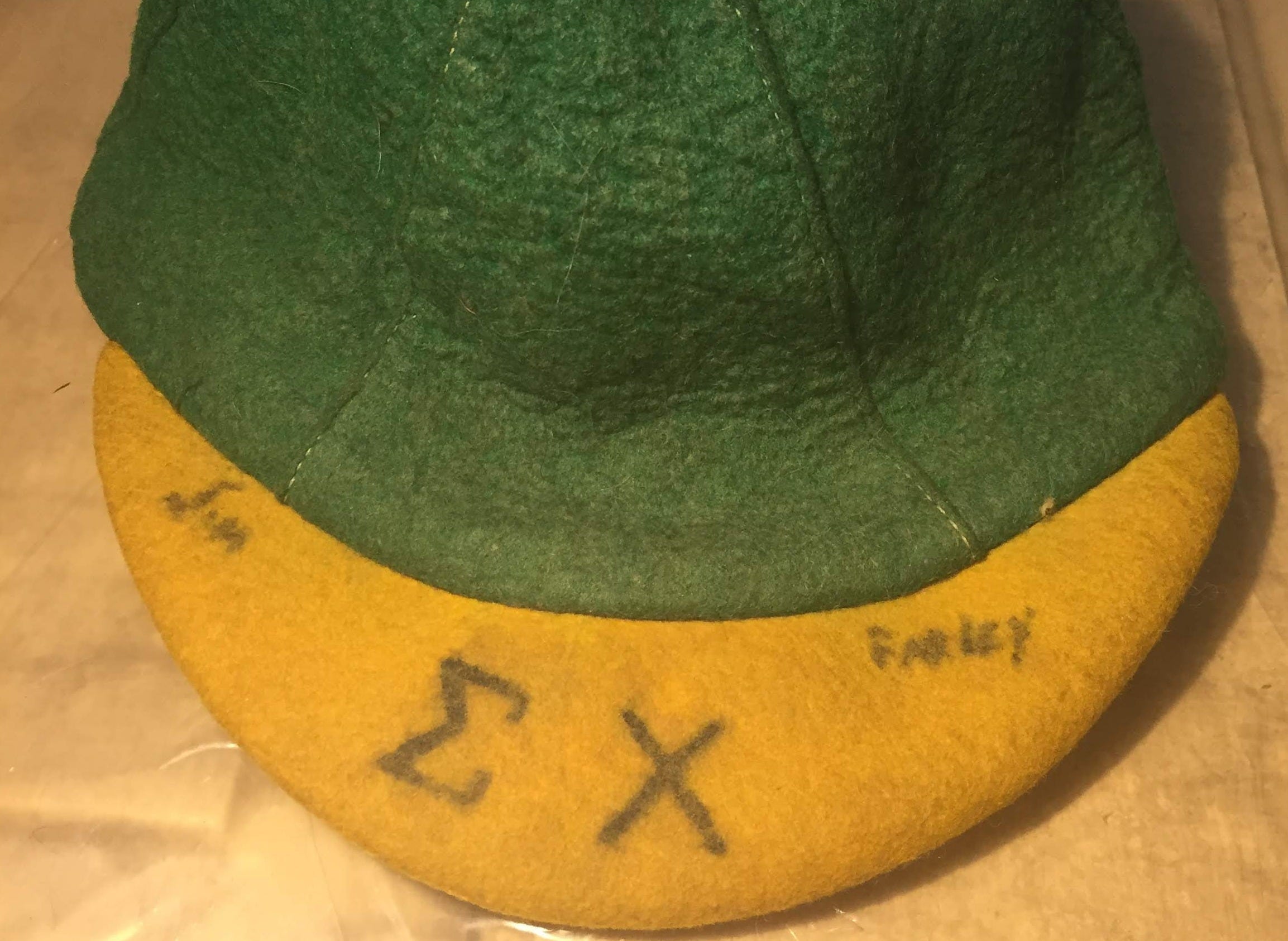
None of this was going to stay in my basement forever. So I searched online for the Albion Sigma Chi chapter and found Doc Mike Kabot, who had been the House Corporation President for about 35 years. I contacted his son Kyle first, then Mike directly.
Mike was thrilled. He was building locked, lighted display cases for the chapter house and had plenty of room. I shipped the beanie, stein, and photos in September 2018. Then I found the fraternity pin and mailed that separately. I provided yearbook pages and the backstory — the V-12 program, the Navy service, the Sweetheart Ball, the chapter presidency. Mike wrote up a historical document to accompany the display and had the photos matted and framed.
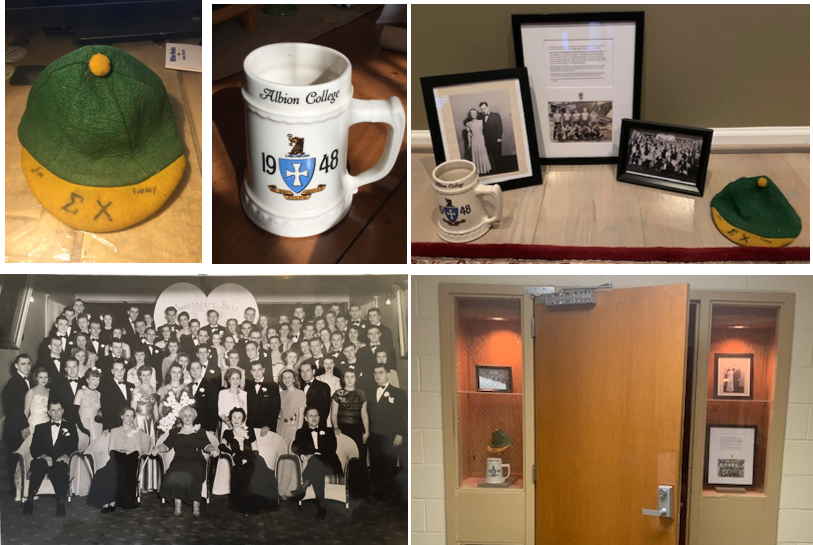
Then I waited. The fraternity brothers started a renovation in the basement where the display cases were going. Then COVID shut everything down. Mike couldn’t get into the chapter house for 20 months. In October 2021 — three years after my first email — he finally got back in and installed everything. He sent photos. My brother Tom’s response: “Takes a manly man to wear a tiny beanie.”
A couple of lessons from this one. First, the recipient matters as much as the institution. Mike Kabot had personal passion for preservation and the infrastructure to do it right. Second, providing the story made all the difference. Mike told me people love seeing memorabilia, especially when there are stories to go with it. Third, patience. Three years is a long time, but the result is a locked display case in a fraternity house that has memorabilia going back to the 1800s. It’s a shrine to Sigma Chi, and my dad’s stuff is part of it.
I told Mike not to hesitate to replace my dad’s items with new donations if better ones came along. The beanie and stein could be more permanent, but the other pieces could be rotated. No need to check with me. The point was preservation, not controlling the display.
The Haldorn Sailing Trophy — St. Francis Yacht Club
This one requires some backstory.
James A. Murray was a Montana Copper King — one of the wealthiest men in the state at the turn of the twentieth century and the subject of a biography I wrote. Murray’s second wife had a son from a previous marriage: Stuart Haldorn. You could say Haldorn spent my great-grandfather’s rightful inheritance in a spectacular fashion.
Among his expenditures: Six Meter racing yachts. The Six Meter class was the glamour division of international yacht racing in the 1920s and 1930s — sleek, expensive sloops built in Sweden and shipped across the Atlantic. Haldorn acquired “Ay Ay Ay” (US 34), which arrived in San Francisco Bay for the 1928 racing season.
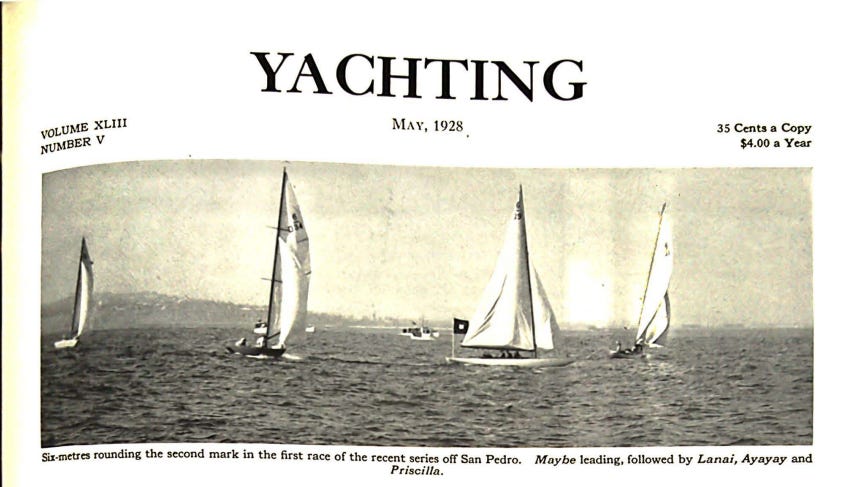
In August 1929, the Pacific Coast Yachting Association held a championship regatta on the Bay. Nine Six Meters entered. The final race became legendary — three boats finished virtually simultaneously under spinnaker, producing one of the most famous photographs in Bay Area sailing history. Ay Ay Ay was declared the winner. That photograph hung at St. Francis Yacht Club until the fire of 1976 destroyed it.
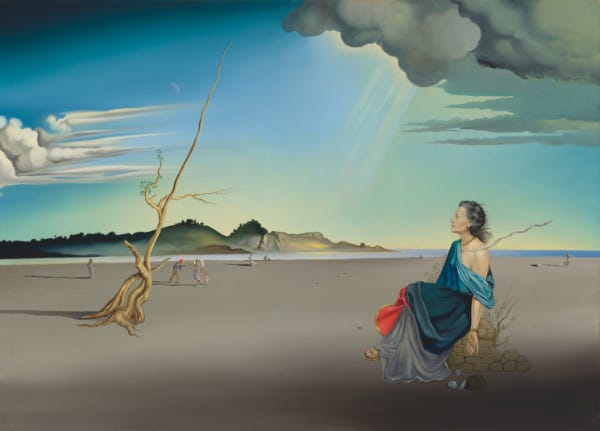
Another Haldorn luxury item: Stuart’s wife, the former Enid Gregg, had her self-portrait painted by Salvador Dali. It hangs in the De Young Museum in San Francisco. I see a tiny sailboat in the background.
Now to the artifact: While researching the Murray biography, I was constantly searching eBay for artifacts connected to Murray and his extended family. A Haldorn sailing trophy from 1930 appeared at essentially scrap metal value. I bought it as a conversation piece and it sat on a shelf for over a decade. This year, I decided it was time to declutter.
I contacted St. Francis Yacht Club. Their curator, Kimball Livingston, responded immediately. He recognized the trophy as one of a series connected to Dr. Albert Soiland, the founder of the Pacific Coast Yachting Association and Newport Harbor Yacht Club. StFYC already had two similar trophies from Six Meter racing, displayed in a lobby trophy case dedicated to Six Meter history. Livingston proposed placing the Haldorn trophy as a companion to those two, enlarging the story.
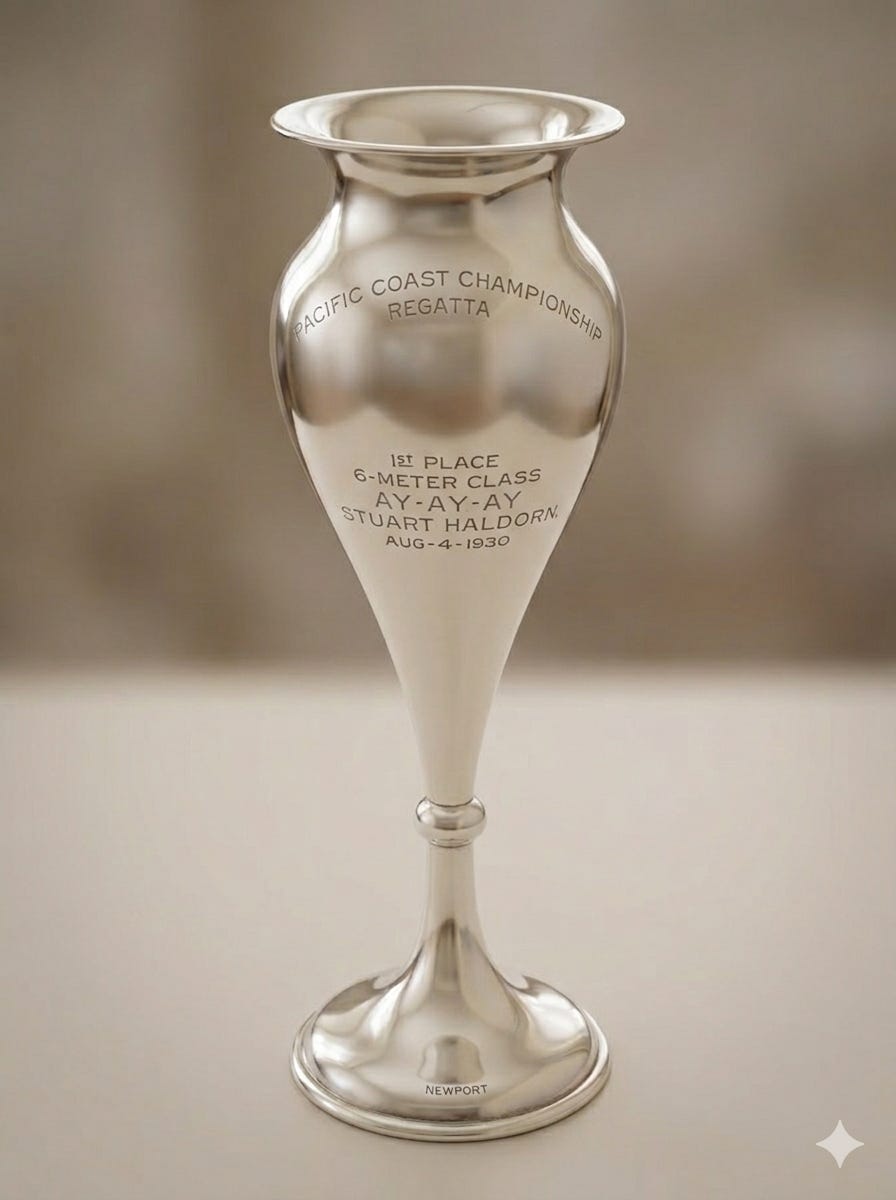
This was the ideal outcome. Livingston wasn’t just accepting a donation — he was a biographer of Dr. Soiland, the centennial commodore of the PCYA, and a former commodore of StFYC who had presided over the 2016 Six Meter North American Championship at the club. He knew the Haldorn and Ay Ay Ay history cold. He committed to entering the full provenance — Haldorn’s story and my contribution — into the club’s member-accessible archive.
His plan for the trophy was better than I could have imagined.
The lesson here is about alignment. This trophy sat on eBay at scrap value because nobody bidding on it knew the story. Without someone who could connect the Murray name, the Haldorn connection, and the Six Meter racing history, it was just old metal. My research gave it context. StFYC gave it a permanent home. When artifact, story, and institution align perfectly, the result is something none of them could achieve alone.
Sacramento Civic Memorabilia — Sacramento History Center
Not all the artifacts I’ve rescued come from family. Some come from my professional career.
I donated several items to the Sacramento History Center recently: a Challenge Coin given to me by the U.S. Army for my work on converting the Sacramento Army Depot, a set of renderings of a potential amusement park on the Sacramento River prepared by Knotts Berry Farm, and a very limited-run baseball cap printed by the mayor for his announcement that he was creating a stadium authority to try and bring major league baseball to the city.
The History Center was grateful. The theme park renderings were of particular interest, and I understood why. Sacramento’s waterfront and adjacent railyards have been the subject of ambitious plans and false starts since about 1992. Massive office towers were envisioned — a significant expansion of the central business district with private sector occupants. Almost none of it materialized, mainly because the railyard owners (Southern Pacific and then Union Pacific) needed high sale prices to offset toxic soil cleanup costs. As of today, the biggest developments on the site are two public courthouses, a hospital under construction, and a minor league soccer stadium under construction. Nothing like what was imagined.
The theme park concept was too early in the process — back when there was still hope for a major private sector build-out. It’s a document of civic ambition that didn’t pan out. About ten years ago, I attended an exhibit in Los Angeles that chronicled all the grand plans for that city that were never realized. Sacramento’s waterfront story belongs in the same category.
The Knotts Berry Farm rendering was the classic dustbin rescue. My successor in the role was about to throw it away. I grabbed it. Nobody archives what didn’t happen — which is exactly why someone should.
Rosa’s Postcards and Rocking Chair — Albion Historical Society (Planned)
This one is still in the contemplation stage, but it illustrates a different path.
My grandfather Guy Barnett grew up on a small farm in Albion, Michigan. His sister Rosabelle — Rosa — was born in 1902. Her world was tiny. The one-room schoolhouse was across the street from the family farm. Town center was a mile away.
On her seventh birthday in 1909, Rosa received picture postcards — birthday greetings and images of towns she’d only heard about. Over the next four years she carefully stored over 100 cards in a large album. Cards came from Jackson, Hillsdale, Grand Rapids, Battle Creek, Lansing, Marshall, and Detroit. She received them on birthdays, holidays, and whenever relatives traveled. Her collecting years coincided with the golden age of American postcards — the U.S. Postal Service delivered over one billion between 1909 and 1915.
Rosa’s collection ended in 1914 when she died of appendicitis. She was twelve. Her brother Guy saved the album and passed it down through the family. He also kept her rocking chair.
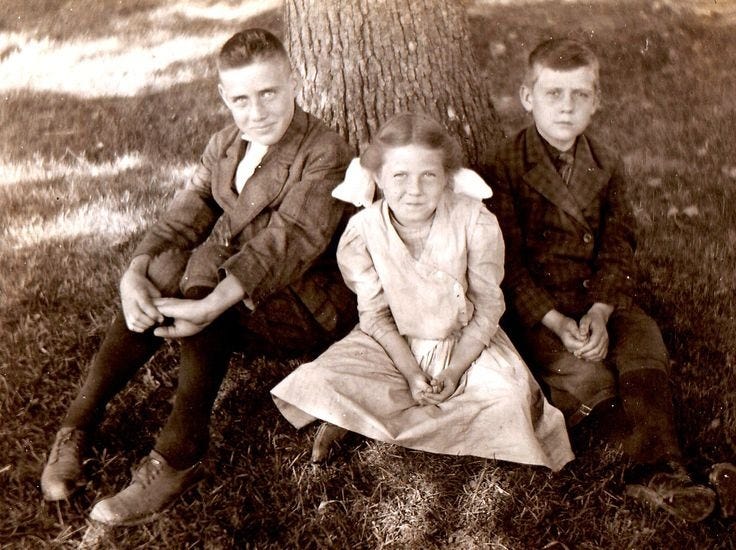
I pitched an article to Michigan History magazine — “The Golden Age of Post Cards: Rosa’s Window to the State” — proposing to tell her story alongside the postcards, with brief histories of each city during the period of her collection. The magazine passed.
But a rejection from a magazine doesn’t mean the story has no audience. I posted Rosa’s complete collection of over 100 cards to Pinterest along with her story. That digital record exists regardless of what happens with the physical items. And the Albion Historical Society maintains a period home from around 1910. Rosa’s postcards and rocking chair would fit the setting and era perfectly. The Albion connection is direct — she lived there. I haven’t contacted them yet, but it’s on my list.

The lesson: a story that doesn’t meet the threshold for a state magazine may be exactly right for a local institution. Different audiences have different needs. And digital documentation — Pinterest, YouTube, scanned images — creates a parallel preservation track that doesn’t depend on any institution saying yes.
Home Movies as Artifacts
Artifacts aren’t just physical objects. My grandfather Barnett’s home movies sat in boxes for decades before I had them digitized. I edited the footage into short clips — one to five minutes each — and posted them to YouTube. Then I joined historical society Facebook pages in the relevant communities and shared the links.
The most polished is a micro-documentary of the 1935 Festival of States parade in St. Petersburg, Florida. I found the newspaper coverage of the parade, identified each float by its sponsor, noted any awards, and added newspaper clips about the crowds. It’s raw home movie footage transformed into something a researcher or filmmaker could actually use.
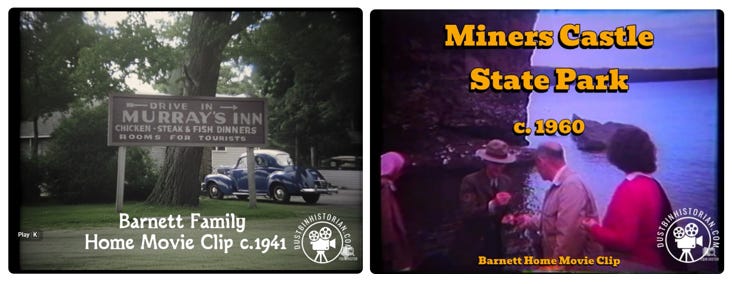
The other clips are simpler but still historically significant. Sailing at White Lake, Michigan, with a cameo of the Murray Inn around 1940. A visit to Colonial Williamsburg. And my favorite: hiking through the Painted Hills and Miners Castle off Lake Superior, circa 1960 — shot before the lookout was constructed and before access to the turrets was cut off. That footage documents a landscape that no longer exists in its accessible form.
I think of these clips as potential B-roll in someone else’s work. They don’t need to be the main feature. They just need to be findable when a documentary filmmaker or local historian goes looking for footage of the 1935 Festival of States or pre-lookout Miners Castle. Unlike a rocking chair or a trophy, a YouTube clip doesn’t require anyone’s permission or shelf space. It just has to be there when someone needs it.
How to Do This
If you’re sitting on family artifacts and wondering what to do with them, here’s what I’ve learned:
Write down the stories while you still know them. The beanie means nothing without “Navy V-12 program, chapter president, met his wife at the Albion library.” A trophy is scrap metal without the Haldorn connection and the 1929 race. Do this first, before you contact anyone.
Think about the artifact’s natural audience. Fraternity items belong with the chapter. Sailing trophies belong at yacht clubs. Civic memorabilia belongs at local history centers. Postcards from Albion belong in Albion. Ask yourself: who would care about this?
Look for institutions with existing context. St. Francis Yacht Club already had a Six Metre trophy case. The Albion Sigma Chi chapter already had a memorabilia room going back to the 1800s. Your artifact is most valued where it fills a gap or enlarges a story that’s already being told.
Find the right person. Doc Mike Kabot and Kimball Livingston both had personal passion for the material. An enthusiastic curator or chapter historian makes all the difference between a box in storage and a lighted display case.
Provide the story with the artifact. Write it up. Include names, dates, connections. Make the recipient’s job easy. Mike Kabot prepared a framed historical document for the display. Livingston committed to archiving the full provenance. They could do that because I gave them the material to work with.
Be patient. My dad’s fraternity memorabilia took three years from first contact to installation. Renovations, COVID, logistics — it all takes time.
Be willing to let go. I told Mike Kabot to rotate items out as needed. The point is preservation and sharing, not controlling the display forever.
Create digital backups. Scan photos, photograph objects, digitize film, post to Pinterest or YouTube. The physical item may eventually be lost, but the digital record persists. Rosa’s 100+ postcards are on Pinterest right now. The Miners Castle footage is on YouTube. Those exist regardless of what happens to the originals.
Don’t overlook your professional life. The Army challenge coin, the Knotts Berry Farm renderings, the mayor’s baseball cap — these tell stories too. And nobody is going to save them for you.
A rejected magazine pitch doesn’t mean the story has no home. Michigan History passed on Rosa’s postcards. But the Albion Historical Society might love them. Different audiences, different thresholds.
Everything I’ve described in this post was headed for the dustbin. The beanie was in a box in my basement. The trophy was on eBay at scrap value. The theme park renderings were about to be thrown away. The home movies were deteriorating in storage. Rosa’s postcards had been sitting in a family album for over a century.
Publishing a story gives an ancestor permanence on the page. Donating an artifact — with its story — gives them permanence in a place. Both rescue lives from obscurity. And both require someone to do the work before it’s too late.