
Fifty Thousand Dollars and a Long Shadow
My great-grandfather’s share of a Copper King’s fortune was enough to buy a restaurant. His cousin’s share was enough to buy a Senate seat.

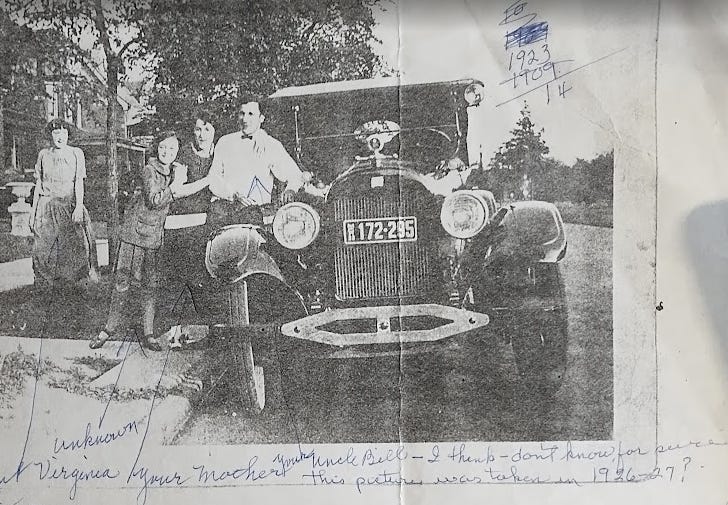
Somewhere in the paperwork my family kept—the kind of paperwork that migrates from a desk to a drawer to a box in the garage over the course of a century—there are letters indicating that my great-grandfather, William Murray, received approximately $50,000 from the estate of James A. Murray.
Fifty thousand dollars in the 1920s was a significant sum. It was enough to change a family’s trajectory. My grandmother Sylvia used part of it to buy a restaurant and bar in Davison, Michigan. Other relatives bought a farm on Cummings Road. When the money arrived, someone bought a new car. There was also, at some point, an ice cream factory. My father mentioned it once—he would get a scoop on his way home from school. When I contacted the Davison Historical Society years later to ask about Sylvia, they had one thing to say: Sylvia was a tough bird.
The money came from a settlement. Not a generous one. Under the terms of James A. Murray’s will, the Daniel Murray branch of the family—my branch—was entitled to 2,000 shares or 25% of the Monidah Trust, the holding company that contained an empire worth $15 million. Daniel was Jim Murray’s brother. Daniel had died in 1907. He never sent any of his eight children out west to serve in his brother’s empire. Jim Murray paid for big grave markers for Daniel and his other brothers—but the gratitude stopped at granite. The will’s intentions never made it to a bank account without a fight. The man who ensured my family received a fraction of what was owed, and who pocketed the lion’s share for himself, was James A. Murray’s nephew: James E. Murray.
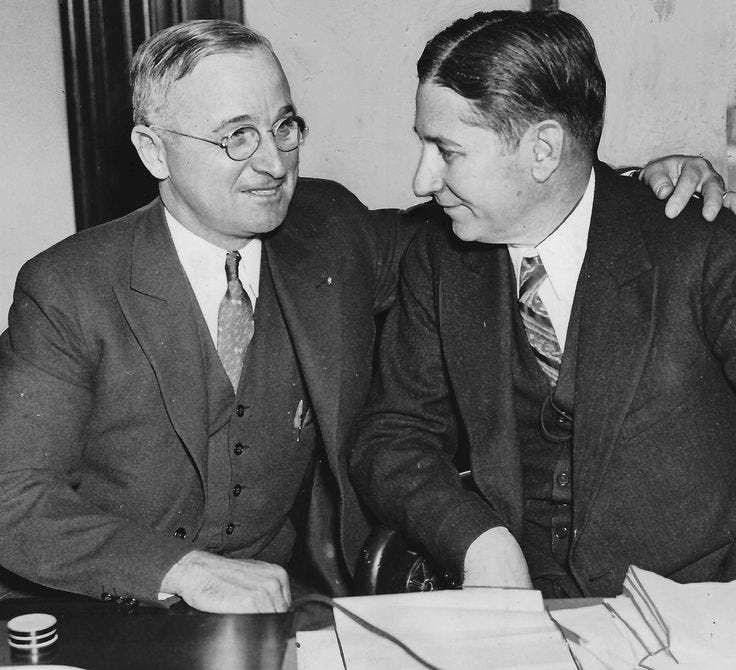
He would later become one of the most consequential United States Senators of the twentieth century. The Saturday Evening Post called him “Millionaire Moses.” Harry Truman said his awards were “richly deserved.” Lyndon Johnson thanked him at the signing of Medicare. He is my first cousin, three generations removed. And the fortune that launched his political career came, in part, from shaking down my side of the family.
I don’t cover this aspect of Murray lore in my academic writing. It only appears in my trade book on James A. Murray. When asked about the shakedown I explain the fortune was long gone when I arrived on the planet. And for my relatives, $50,000 just ahead of the Depression was a life-line. All of that money is just a memory four generations removed from that battle. The memory became a story I’m telling you now.
The Uncle’s Workhorse
James E. Murray was the son of Andrew Murray, one of Jim Murray’s brothers. Andrew died in Canada in 1887. After Andrew’s death, three of his children—James, Marcus, and May—moved with their mother to Butte, Montana, where their uncle had built a sprawling business empire from mining, banking, real estate, newspapers, theaters, and resorts. Uncle Jim Murray had no biological children of his own. He treated his nieces and nephews like employees.
He put Marcus and May through college, then rotated them among his banks in Utah, Seattle, Tacoma, and Butte. For James, the eldest, he extended a line of credit to attend law school at New York University. James graduated, returned to Butte, opened a private legal practice that represented his uncle, and eventually became one of three officers of the Monidah Trust—the Delaware corporation that held virtually all of Jim Murray’s assets.
James spent the next two decades serving his uncle’s business and political interests. He managed legal matters, ran Irish-American political organizations at the national level, and kept the family’s complicated web of enterprises from tangling. He raised money for Ireland’s revolution. He presided over a national organization dedicated to Irish independence. He did all of this with his uncle’s money and under his uncle’s shadow.
Jim Murray never publicly praised his oldest nephew. Not once.
The Will
James A. Murray died on May 11, 1921, at his sprawling seaside mansion in Monterey, California. He was eighty years old. His will, executed just four months earlier, was deceptively simple. He had transferred everything into the Monidah Trust. The will directed that stock certificates, pre-endorsed on the back to his chosen beneficiaries, would be found in a sealed envelope. Whoever’s name was on the certificate got those shares.
His wife, Mary, was at his bedside when he died. She was likely the first to find the certificates. There were eleven of them dividing 9,500 shares of the estate. She and her son Stuart Haldorn opened them one by one.
Neither of their names appeared on a single certificate.
The biggest prize—a certificate for 4,000 shares, was endorsed to James E. Murray. He received two other certificates with a total of 512 shares. Daniel Murray’s estate received 2,000. Marcus got 1,000. May got 500. Eliza Murray Poole— one of Daniel Murray’s daughter, the one who had faithfully tended the family graves back east—received 500 of her own. The last certificate, for 988 shares, was left blank, meaning it passed to Mary under the will’s residual clause.
Mary and Stuart had expected to inherit the empire. Instead, they inherited a residual clause and a grudge.
The Forgery
Here’s my take on what likely happened. Their first move was almost immediate. Mary—or someone looking out for her interests—carefully changed the middle initial on James’s 4,000-share certificate from an “E” to an “A.” The claim would be that Jim Murray had endorsed this certificate to himself, not his nephew. If it was James A.’s own certificate, it would pass to Mary under the residual clause. They placed the altered certificate back in the envelope, typed Stuart’s name on the front, and waited for the attorney to arrive.
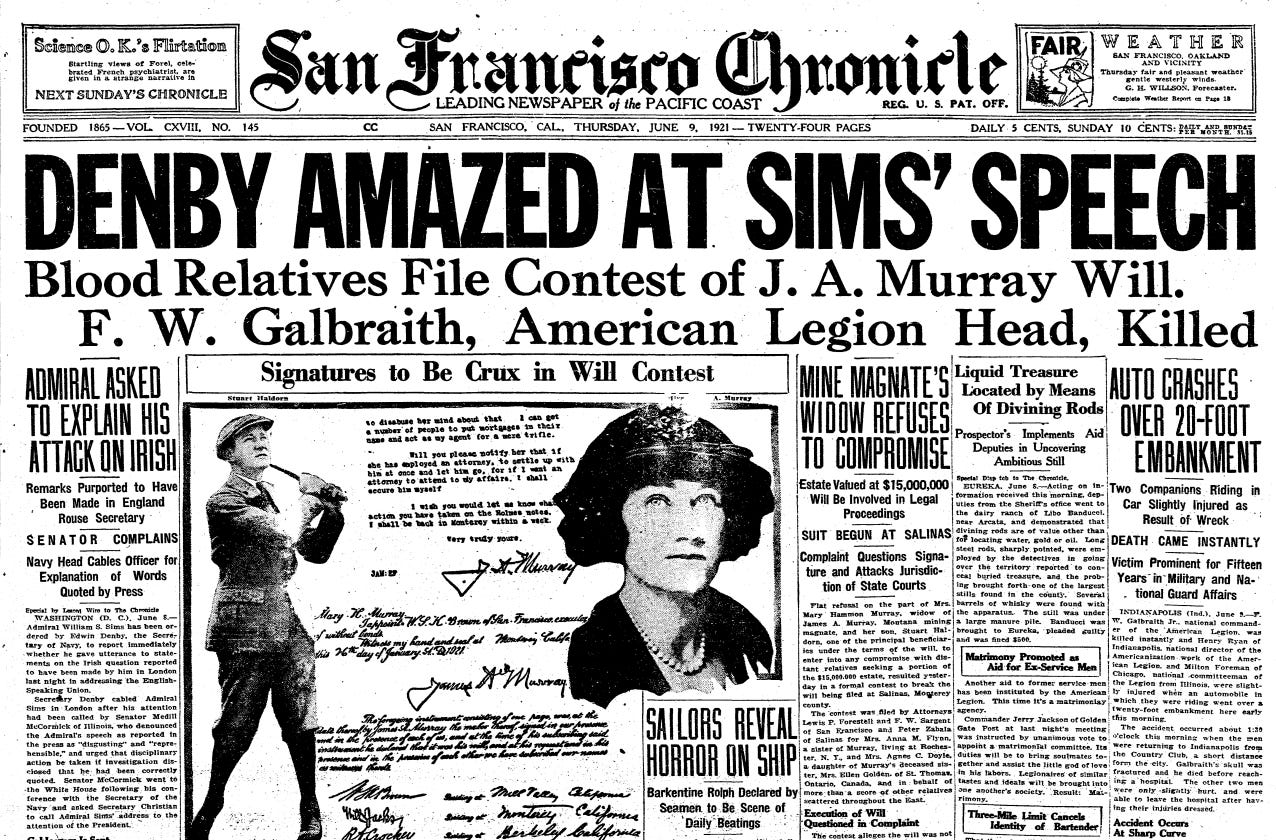
James E. spotted the fraud immediately. Within weeks, the fight made the front page of the San Francisco Chronicle: “Blood Relatives File Contest of J.A. Murray Will.” The paper ran photographs of Mary and Stuart alongside facsimiles of the contested signatures. The estate was valued at $15 million. The widow, the paper reported, refused to compromise.
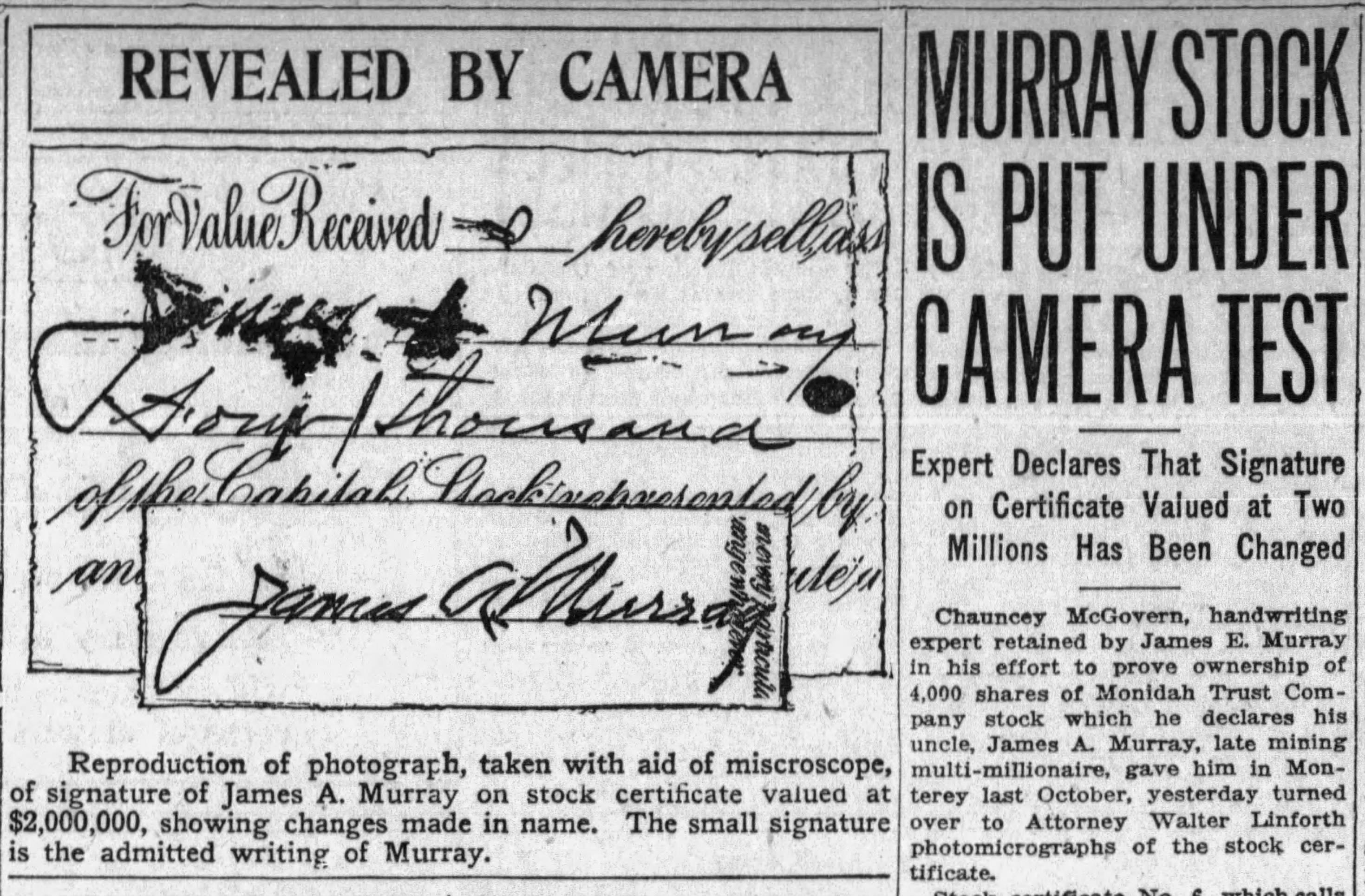
Nineteen days after his uncle’s death, James E. sat down in San Francisco and wrote a letter to Ed Fletcher, Jim Murray’s business partner in San Diego. The letter is desperate and strategic in equal measure. He describes seeing the certificates with his own eyes: two for five hundred shares each endorsed to May, and “one certificate for four thousand endorsed to me, but my name was written over and obliterated.” He tells Fletcher he has received telegrams from “our most substantial people in Montana” urging him to stand firm. He says he and Mary are “the only ones entitled to much compensation as we have borne the brunt of things for almost a life time.” He closes by asking Fletcher to keep the letter confidential.
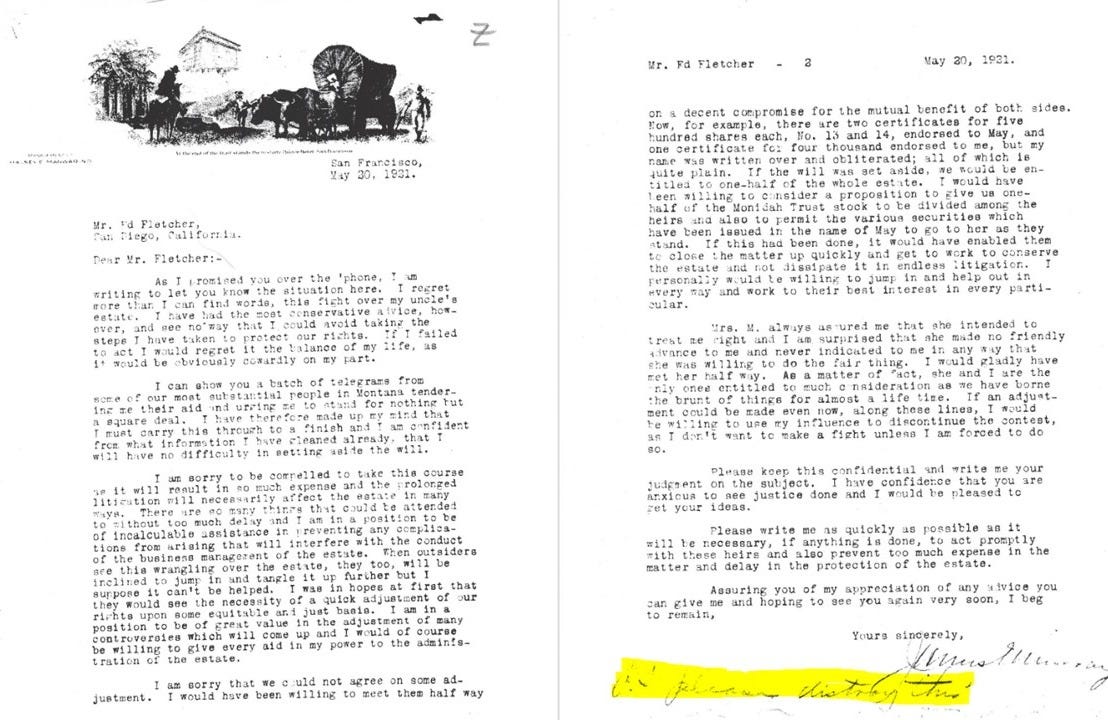
Fletcher did not keep it confidential. He turned the letter over to Mary as evidence in the probate proceedings. Mary had already offered to forgive Fletcher’s $80,000 in personal loans from her late husband in exchange for his cooperation against the heirs. Fletcher chose the money. James E.’s plea for help became a weapon used against him.
James E. filed suit and won his shares back in court. And then something remarkable happened.
He and Mary joined forces.
The Shakedown
It took four months of mudslinging before the two realized they had a bigger problem than each other. Twenty-six relatives had swarmed the courts in Monterey, Butte, and Seattle, all claiming a piece of Jim Murray’s fortune. Mary was about to be forced to testify under oath about the tampered certificate. So she and James struck a deal. They would stop fighting each other and start fighting everyone else.
James and Stuart Haldorn traveled east to confront the potential heirs—most of them James’s own cousins, spread across Michigan, Pennsylvania, and Canada. Their approach was not subtle. They demanded immediate cash from the claimants to cover inheritance taxes, warned that actual distributions would take years, and offered a fraction of each heir’s interest as a settlement. For any relative living in the United States who had not been naturalized, they added a special incentive: accept the offer, or we’ll have you deported.
The family remembered. Decades later, my father’s aunt Margaret wrote him a letter about the Murray story. Her assessment of Senator James E. Murray was unvarnished: “Senator Murray of Montana was an attorney and he was a crook! He made Pa sign off paper which otherwise would make him well-to-do—He threatened Pa’s illegal stay in the country.”
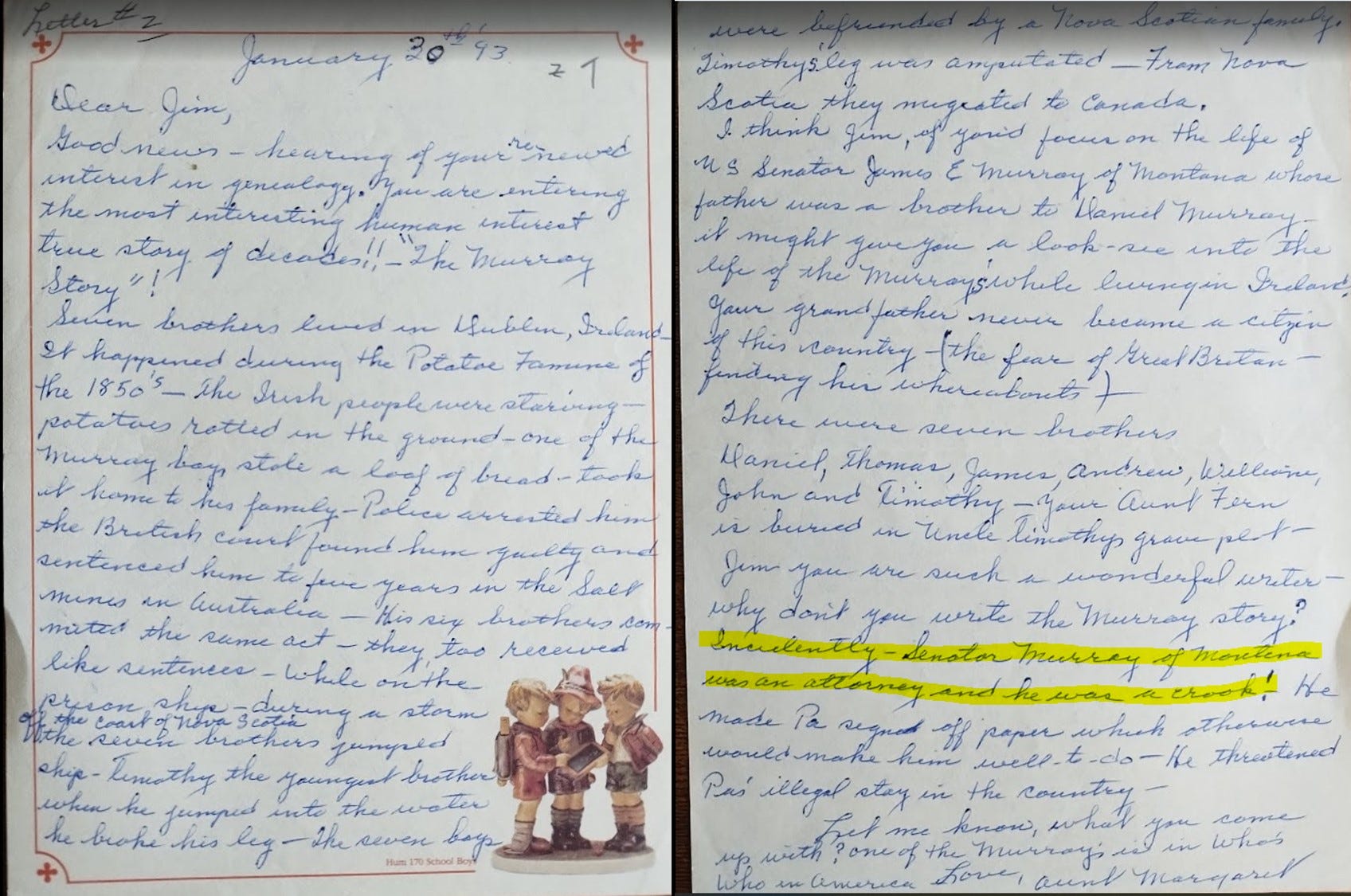
That is the family’s oral history of the estate fight, passed down from the generation that lived it. The Supreme Court documents describe the same events in legalese. Aunt Margaret’s version is better.
It took six years to tie down all the agreements. In the end, 6,000 shares were used to divide the estate. Mary received 3,100. James, May, and Marcus split 1,500. Thomas Murray’s family received 500. The remaining relatives split 900. There were plenty of assets that fell outside the settlement, side deals that remained secret. The executor filed his final accounting in 1930, nine years after Murray’s death. His report only included items that were publicly disclosed.
My great-grandfather, William S. Murray—Daniel’s son—did not go quietly. He took the fight all the way to the United States Supreme Court. In Murray v. Monidah Trust, William and the other minority shareholders argued that the estate’s assets should be distributed on the basis of 6,000 shares, not the full 10,000-share capitalization—a formula that would have significantly increased their payout. They also alleged that James E. and Mary had entered into a “secret and collusive agreement” to split the contested 4,000 shares between them, and that May Murray’s $300,000 in notes and certificates had been converted through a sham lawsuit. The court found nothing in the agreements to support their claims. May Murray, an indispensable witness, had died. The right to prosecute, the court wrote, was “barred by laches and inexcusable delay.” The decree was affirmed.
William S. Murray’s share of what remained came to approximately $50,000. James E. Murray’s share came to approximately $3 million, plus whatever fell off the books. He later told a constituent that he had “inherited practically nothing” and was “merely compensated for a lifetime of service to my uncle.” I agree. He dismissed his uncle’s business acumen as “blind luck.” To this I disagree strongly.
Millionaire Moses
Whatever you think of how Senator Murray got the money, there is no disputing what he did with it.
After the stock market crash of 1929 took a significant portion of his capital, James E. Murray reentered politics. He chaired the Silver Bow County Democratic Central Committee, campaigned for Franklin Roosevelt in Montana, and was appointed to the state’s Public Works Administration Board. In 1934, at FDR’s request, he ran for and won a seat in the U.S. Senate. He served for twenty-six years.
His legislative record was extraordinary. He authored Senate Bill 380, which became the Employment Act of 1946—the law that created the Council of Economic Advisors. Economist John Kenneth Galbraith later called it the most important piece of economic legislation of the postwar years. He coauthored the Wagner-Murray-Dingell Bill, the nation’s first proposal for comprehensive national health insurance. Twenty years later, President Johnson recognized Murray’s work at the signing of Medicare, saying the legislation was made possible by “the long-enduring, and often thankless, efforts of earlier Presidents and earlier Congressmen.”
FDR trusted him enough to detail forty percent of the Executive Branch staff assigned to Senate committees to Murray’s operation. The Saturday Evening Post profiled him as “Millionaire Moses”—the wealthiest member of Congress and among its most progressive. Hubert Humphrey called him the “staunchest advocate of social legislation in the United States Senate.”
He survived a reelection campaign in which the Republican opposition used literature casting him as a Communist, winning with support from Senators Al Gore Sr. and Lyndon Johnson. He retired on January 3, 1961, and died less than three months later, ending what I have called—in a peer-reviewed journal, no less—the Murray family’s “unique seventy-eight-year span of radical politics.”
Getting Anyone to Care
I published the dual biography of James A. and James E. Murray in Montana: The Magazine of Western History in 2016, under the title “Rocky Mountain Radicals.” It took twenty-one months from submission to publication. The first version was rejected without peer review—the editors said it lacked interpretation. The second version split the reviewers. The third version was accepted as a simple biography. I learned that writing about your own relatives in an academic journal requires you to prove, repeatedly, that you are not simply writing about your own relatives.
The article on James E. Murray’s role in FDR’s legislative strategy went to several journals before the Journal of Policy History accepted it in 2020. The subject matter—how FDR detailed Executive Branch staff to Murray’s Senate committees to push the Second Bill of Rights—combined my independent scholarship on Murray with my PhD work at Virginia Commonwealth University. I identified the gap in the literature during a review course on the history of public policy. I suppose there is something fitting about discovering that nobody had written about your cousin’s most important contribution to American governance while sitting in a graduate seminar.
The Bygones
Here is the part I cannot fully explain.
After the settlement—after James E. and Stuart Haldorn traveled east to strong-arm the blood relatives into accepting a fraction of their inheritance, after the threats and the deportation warnings and the six years of legal maneuvering, after my great-grandfather took the fight to the Supreme Court and lost—James E. Murray came to Davison, Michigan, and slept under my grandmother’s roof.
The Flint Journal ran a notice on July 3, 1938: “Senator Murray Is Guest Of His Kin at Davison.” United States Senator James E. Murray of Butte, Montana, was a guest of his cousins, including my grandmother and Aunt “He was a Crook” Margaret (Mrs. James Harvey in the article).
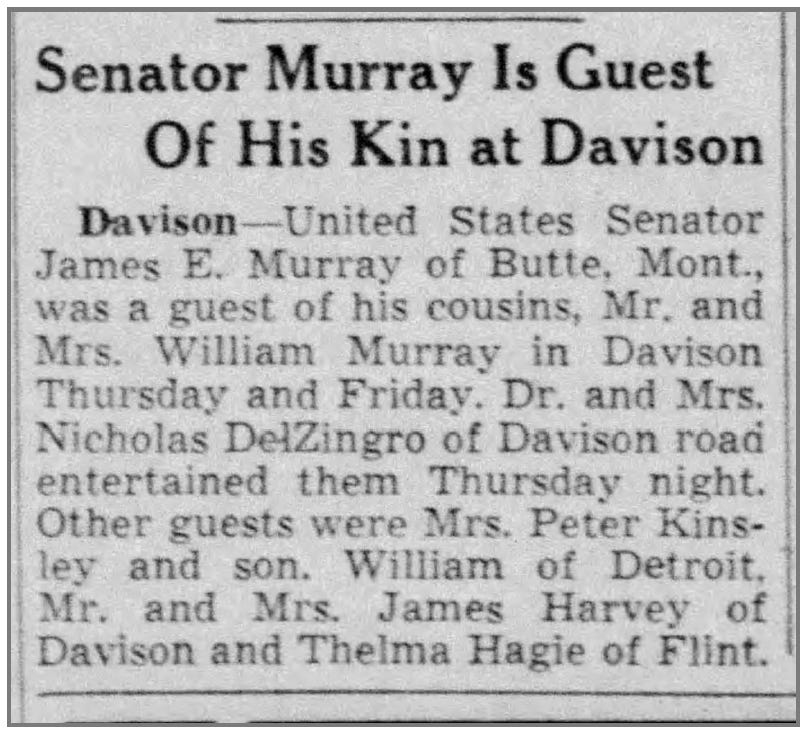
If you read the previous post, you know Dr. Del Zingro. He was the Davison town doctor, the civic fixture, the man who hosted politicians and supported local charities. He was also Sylvia’s second husband—my father’s stepfather. The man who entertained the senator on Thursday night was married to the daughter of the man the senator had frozen out of a Copper King’s fortune.
My father was thirteen years old in 1938. He may have been in the room.
I do not know what was said that evening in Davison. I do not know whether anyone raised the subject of the estate, or the Supreme Court case, or the altered stock certificate. My relatives also visited James E. in Washington, D.C., after he became a senator. What I do know is that the connection held. It held long enough and firmly enough that my grandmother Sylvia—the tough bird with the restaurant, the woman who turned Murray settlement money into a business—felt she could pick up the phone and call in a favor.
The Phone Call
During World War II, my father spent summers in officer training classes and then took a break after his sophomore year in college to serve in the Naval Reserve in the Philippines. If you read the previous post, you know the broad outlines: the man who wanted a bigger ship, the letters to Marlyn, the career that took him from Albion College to the deck of LCT 726 in Subic Bay.
What I did not include in that post was this: at some point during his training to command a ship, Sylvia used the Murray connection to arrange a transfer for her son. She wanted him moved from naval studies over the medical corps. A U.S. Senator’s office could make that kind of thing happen. One day he was called in to the Commanding Officer’s quarters. The first question put to my dad, “who do you know.” My dad did not know how to respond. The C.O. offered him the chance switch tracks. Dad refused.
My dad told me this story a few weeks before he passed. He choked up telling it. He said it was his mom behind it. Sylvia—who had buried a marriage, bought a business with inheritance money, and maintained a connection to a United States Senator who had once come to Michigan to shake down her father’s family—had tried to keep her son out of harm’s way.
He didn’t take the transfer. That was the kind of man he was. But she made the call. That was the kind of woman she was.
The Long Shadow
Senator James E. Murray cast a long shadow. I teased this line at the end of the last post, and I meant it in more ways than one.
His shadow falls across the Employment Act of 1946 and the Medicare Amendment to the Social Security Act. It falls across the legislative history of the New Deal and the postwar labor movement. It falls, for the handful of people who read peer-reviewed journals about mid-century Senate procedure, across the story of how FDR blended executive and legislative power to advance the Second Bill of Rights.
But in my family, the shadow is more personal. It falls across a $50,000 settlement and a restaurant in Davison, Michigan. It falls across a phone call to a C.O. of officer training and a son who refused the favor his mother arranged. It falls across the visits—the ones I cannot explain—where the man who took the money and the family he took it from sat down together and let the bygones be bygones.
Murray’s vast fortune, the equivalent of $3 billion in today’s economy, has splintered and dissipated. My branch got $50,000 and a tough bird with a long memory. His branch got the Senate. My great-grandfather took the fight to the Supreme Court and lost. Then, somehow, the connection between the two branches was never severed. That is an inheritance for which I am grateful.
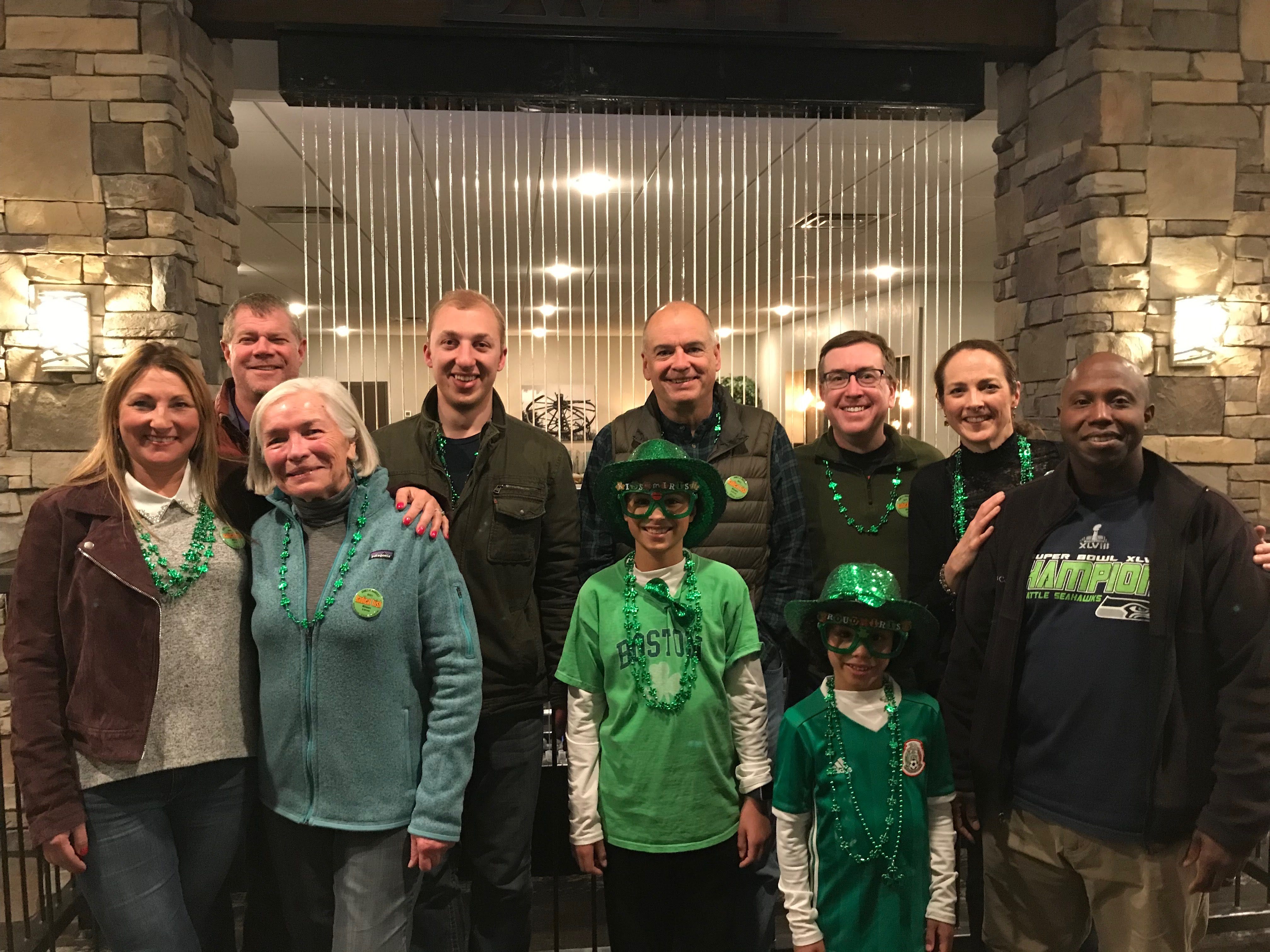
P.S. I am a second great-grandnephew of James A. Murray and a first cousin, three generations removed, of Senator James E. Murray. I wrote a book about the uncle and two peer-reviewed articles involving the nephew. At a reunion with Senator Murray’s direct descendants at Butte’s St. Patrick’s Day parade, nobody mentioned the stock certificates. Some shadows are better left where they fall.