The Longest Bike Trip: From NBC Sports to the Salvation Army
In 1964, my uncle was launching NBC's answer to Wide World of Sports. By 1967, he was in jail. This is the story the three-sentence obituary didn't tell.

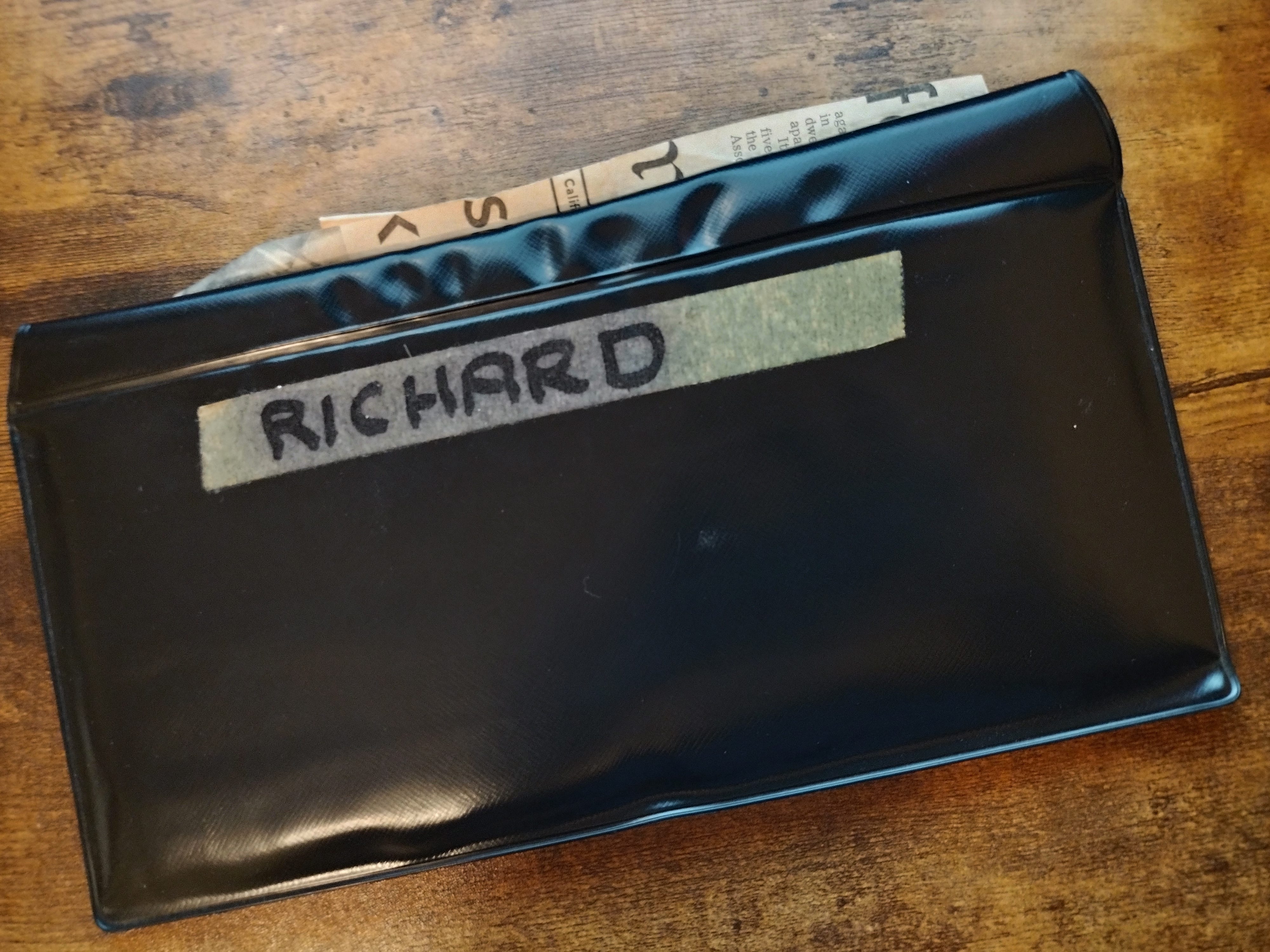
After my mother died in 2012, I found a black vinyl pouch labeled simply ‘Richard.’ I left it alone for years. When I finally opened it, I found a map of a crash site, 12 pages of handwritten notes documenting three years of hell, and one engineer’s desperate attempt to save his son with data.
This is my uncle Richard Barnett’s story. It’s also a story about what gets lost when we reduce a life to three sentences in an obituary—and what gets saved when someone cares enough to do the research.
This is what I do: I rescue stories from the dustbin of history. Subscribe to follow along. Now, let me tell you about the man with a pen, the literary bike trip that cost $1 a day, and the longest journey of all: the one from the peak of fame, through the valley of the shadow, and finally, home.
Every sports journalist remembers their “Day One.”
For some, it’s a shivering sideline in a small town; for others, it’s a high-school radio booth with a faulty mic and a dream.
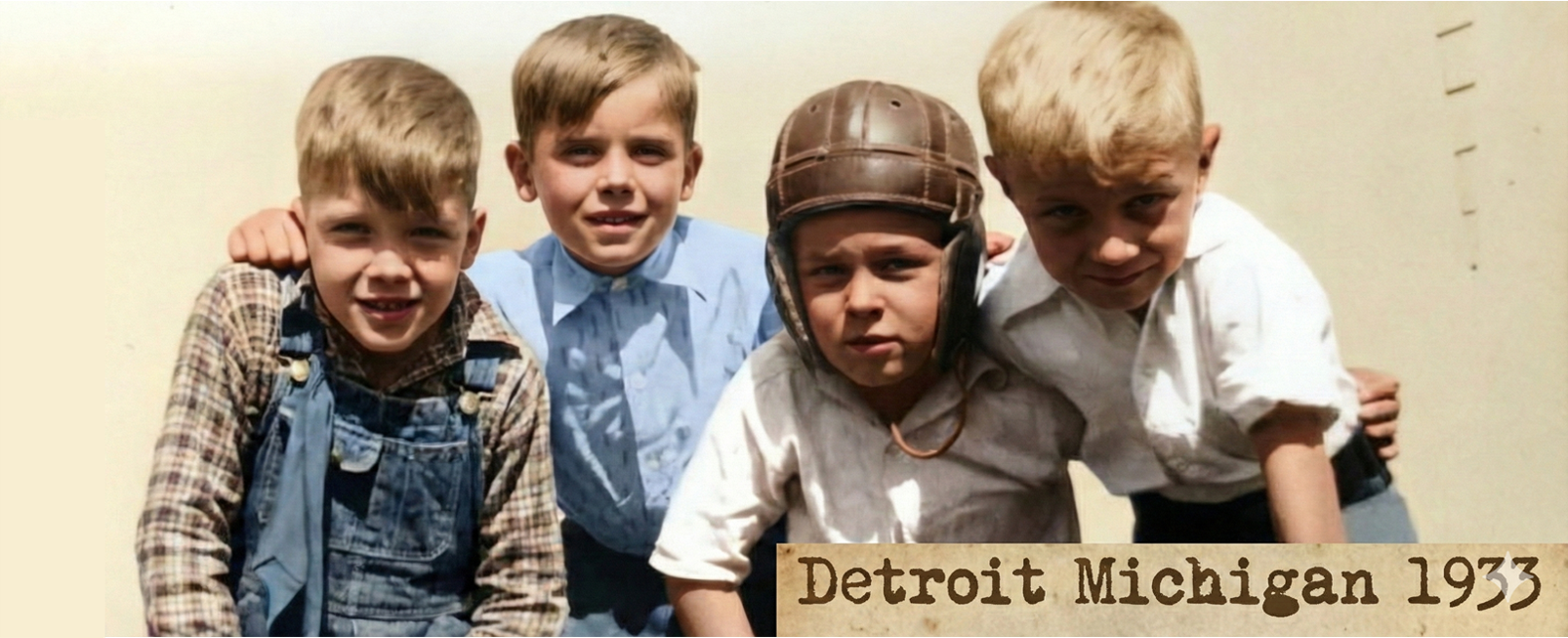
In the early 1940s, Richard Barnett was the kid behind that mic at Detroit’s Redford High. Before he was a witness to New York City’s burgeoning art scene, he was a sports announcer and the Editor-in-Chief of his high school yearbook. He was a young man finding his voice at a time when high school sports were front page news.
Richard’s backdrop wasn’t just any city—it was the Detroit, the heart-beat of America’s industrial revolution. He got to experience the rise of Detroit every day. Guy Delos Barnett, his father was a body engineer who clawed his way up to Chief of Body Engineering for Chrysler.
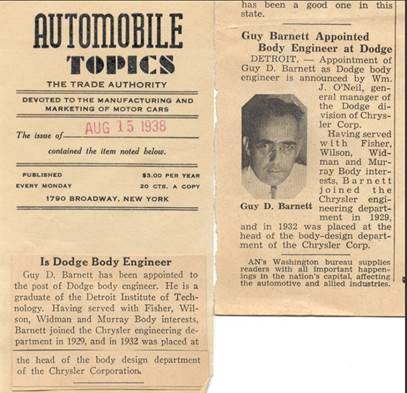
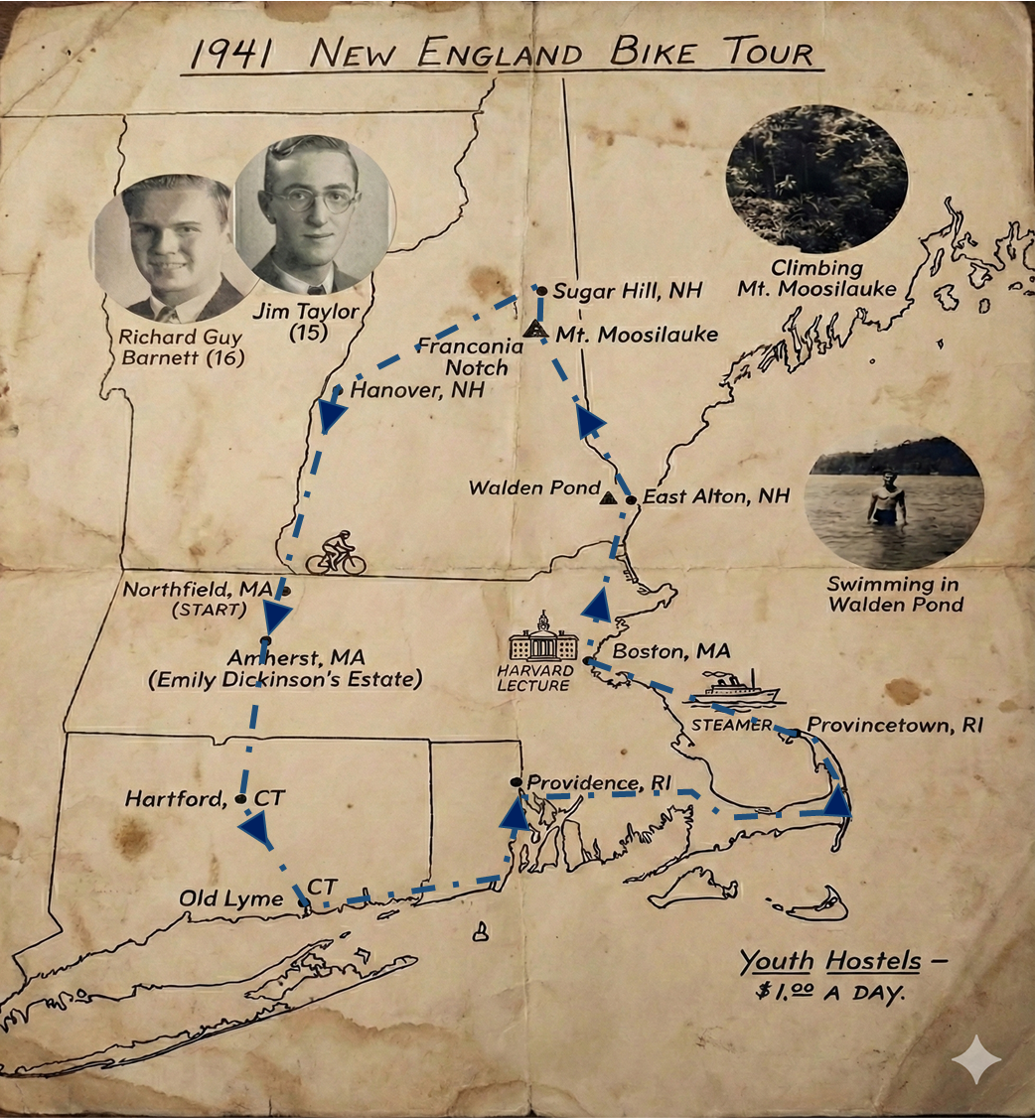
Imagine the dinner table conversations. While Guy was test-driving the latest prototypes brought home from the factory, Richard was learning the mechanics of a different kind: the craft of story-telling. On occasion when the family took winter trips to Florida, you would find Richard checking out books from the local library. When he was 16, he embarked on a self-made literary tour of New England with his pal and fellow scribe Jim Taylor.
Taylor, 15, documented that summer trip in detail. It was 1941. Richard had just been gifted a bicycle and Jim knew where he could rent one at the start of their journey. Richard’s mother, on her way with daughter Marlyn to visit the orphanage where she was raised, dropped the pair off in Northfield, Massachusetts. The plan was to make a thousand-mile loop, stay in youth hostels, and return to Northfield for a ride home.
The pair travelled south to Amherst where they located the vacant home of Emily Dickenson. They noted a residence that was inhabited and knocked on that door. They were greeted by Madam Bianchi, Dickenson’s niece. She invited them to join her for breakfast the next day. The two writers headed to the library to prepare for their morning meeting. Bianchi, accompanied by a “European Count” (later found out to be a con-man), regaled the boys with stories of Dickenson as they sat under the watchful eye of a portrait of the famous poet. With their first experience under their belt, they continue south through Connecticut to the Long Island Sound.
During their loop through New England, they visited Boston and walked the Freedom Trail, stood on the bridge where the first shots were fired in the Revolutionary War, attended a lecture at Harvard on “The Psychological and Sociological Effect of Radio on the Masses” and listened to Carl Sandburg narrate Edwin Markham’s famous poem, “The Man with the Hoe.” Later they swam in Walden’s Pond, dropped a couple stones on the site of Thoreau’s cabin, and visited the home of Ralph Waldo Emerson.
Then they pedaled north through the White Mountains and hiked to the top of Mt. Moosilauke. There on the summit, where you could see the Atlantic Ocean on a clear day, they met group of students from Dartmouth staffing summer camps and a meteorological station. As they turned south, they travelled to Hanover to visit Dartmouth College. A few days later they arrived in Northfield to catch a ride home. Jim kept all the receipts along the way. The final total, each of the boys spent $1.00 a day for their 1,000-mile literary trip through five states.
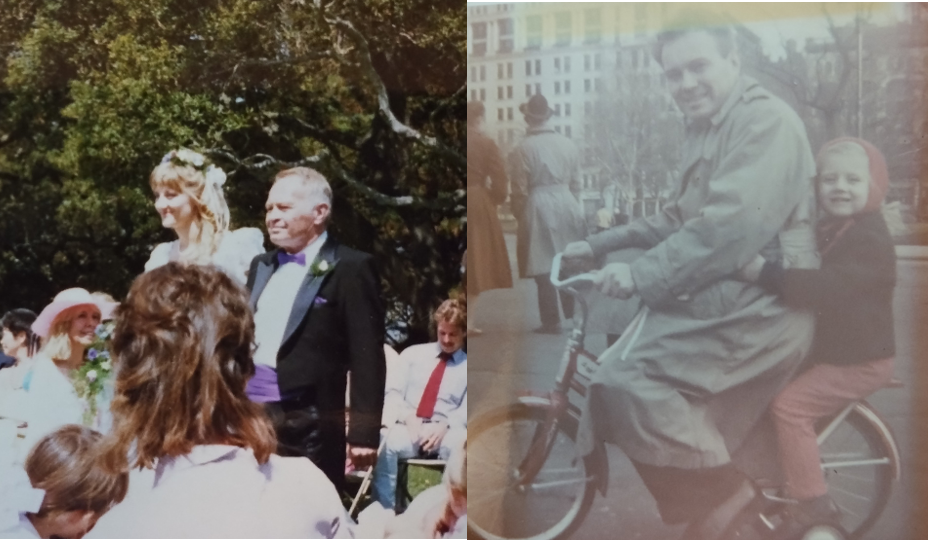
Richard graduated from High School, served in the military during WWII and launched into his career. The trajectory was vertical. Richard hit every beat with precision. He made his mark in New York City and met his wife, aspiring actress Elizabeth Pratt. They lived just a quarter mile from each other at the time in Chelsea. They married in 1949 and had a daughter, Vincent in 1957. Vincent’s earliest memories are being surrounded by artists and actors. Photos from that time capture family gatherings, scenes from NYC and Richard and Elizabeth attending the private wedding of Richard’s sister Marlyn in Detroit.
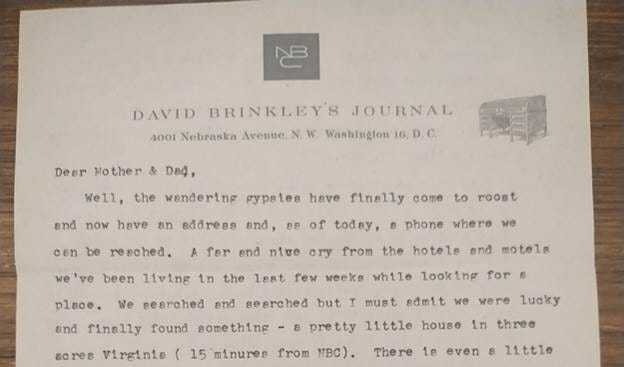
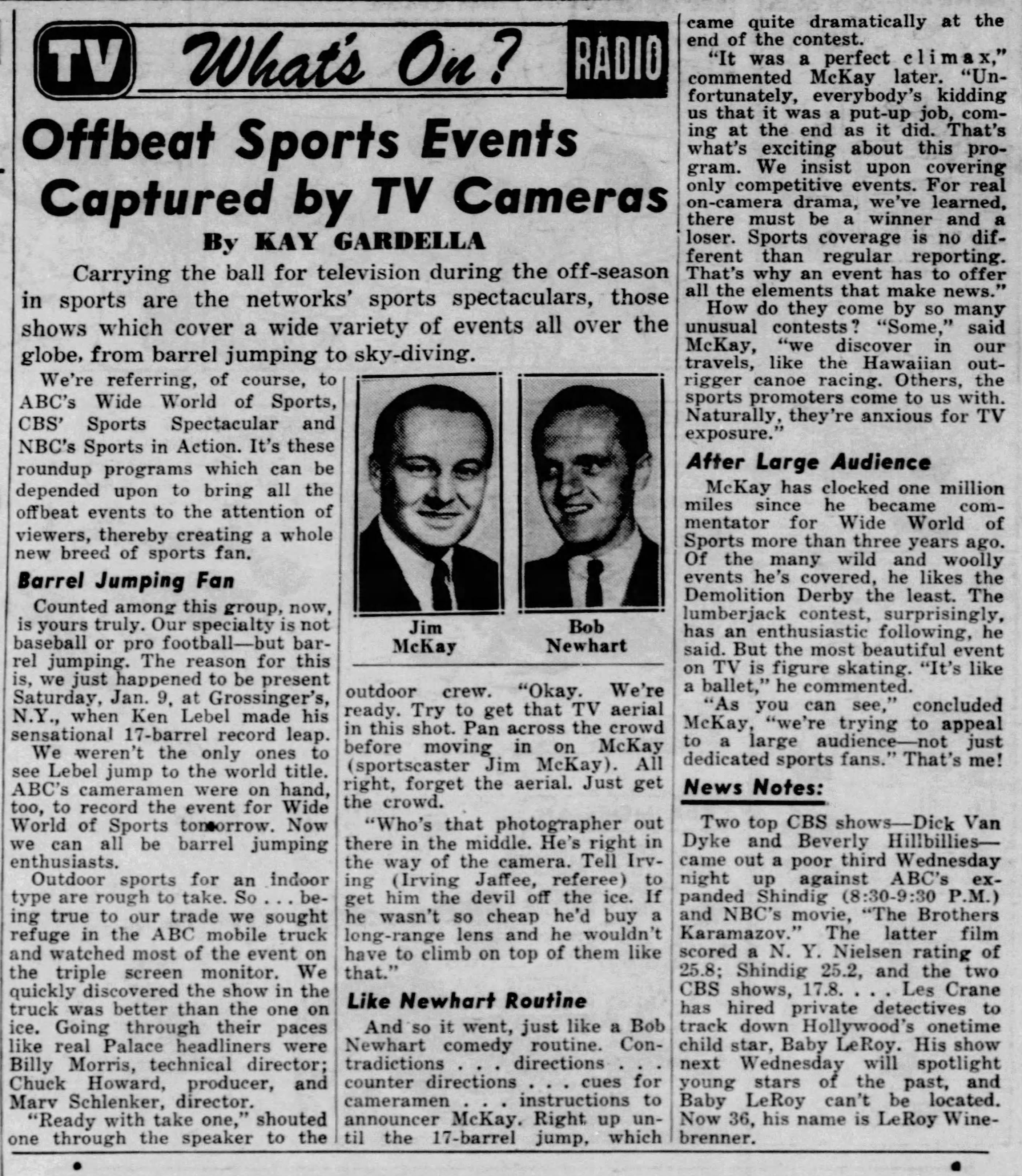
In 1964 Richard, just shy of his 40th birthday, got his big break. He moved the family to McLean, Virginia to work on David Brinkley’s Journal. Shortly thereafter he was assigned to help launch NBC’s response to ABC’s wildly popular Wide World of Sports. Richard was in the thick of it, about to travel the globe. He wrote to his parents, now living in Sacramento next to his sister Marlyn, on David Brinkley’s letterhead. “We searched and searched …and found something – a pretty little house...15 minutes from NBC.” He thought they might get a dog or even pony for Vincent. He wrote of moving from Brinkley’s Journal to “an NBC Sports Spectacular that will go on in the New Year. It will be all about different sports in Ireland, Germany, etc…every kind of thing and hasn’t really been set any more than that yet.”
“Bowed by the weight of centuries he leans / Upon his hoe and gazes on the ground, / The emptiness of ages in his face...”
Edwin Markham, The Man with the Hoe
I found the next chapter in Richard’s life in a black vinyl pouch in my mother’s things after she passed in 2012. I left it alone until now. Simply labeled “Richard,” it was a collection of notes, news clippings, business cards, letters, a map of a crash site and one hand-drawn graph.
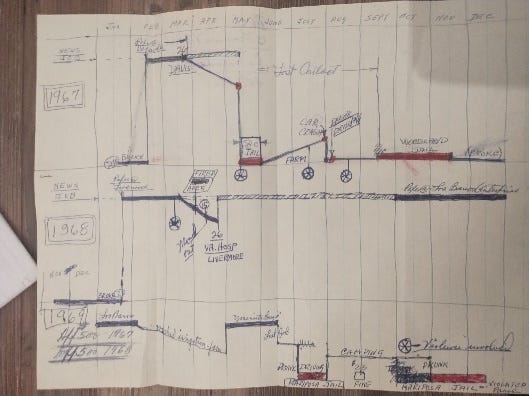
The first letter in the portfolio came from jail. Richard, who was working at a cannery at the time, wrote to his dad, “You can get all my clothes from Cliff Harrington (50 yrs old – heavy, spectacles – straw hat) around 6 PM at the Canton Café. They are in the back of his car.” The substance of the pouch, however, were Granddad’s notes. Twelve pages of single-space handwritten notes documenting three tortuous years from 1967 to 1969. And that graph? It was an engineer grasping at anyway to reach a son who was ravaged by alcoholism and perhaps, underlying psychological disorders.
According to Granddad’s notes, the job at NBC ended badly and Elizabeth divorced Richard shortly thereafter. Richard accepted his mom and dad’s offer to join them in Sacramento, California, where they had retired close to Marlyn and her family. That first letter, looking for help to retrieve clothes from a stranger in a straw hat, was preceded by Richard rolling his VW Bug after a night of drinking outside Winters, a small farm town. The CHP found Richard in a field, thrown from his car at 11 PM. They left him there, checking again at 5 AM to find him still passed out. A week later they cited him for drunken driving and sentenced him to jail.
Richard lost his cannery job while he served out his DUI sentence in a Woodland City Jail. After that he worked at carnivals and other odd jobs, stayed at roadside motels, drunk a lot, fought a lot, and spent weeks in jail. There were glimmers of hope during those tortuous twelve years. He landed a job at a local paper in Livermore, California. Four months and four fights later he was on the road again (fight in a bar, assaulted speaker at a Rotary Meeting, threw wastepaper baskets in the newsroom and assaulted a host at a private dinner club). This time he found work at Yosemite National Park, and shortly thereafter, two stints in the Mariposa County Jail.
Granddad’s graph stops tracking Richard’s spiral in 1968. It conveyed three years of events and illustrated the correlation between new jobs and success, and drinking and failure. Jail time is highlighted in red. Granddad found his skills as an engineer could not help his son.
Seven years of archival silence followed.
“How will you ever straighten up this shape; / ... Give back the upward looking and the light; / Rebuild in it the music and the dream?”
Edwin Markham, The Man with the Hoe
The paper trail picks up again in the fall of 1976. Now living in San Francisco’s Mission District, Richard writes to his parents “the hardest letter I‘ve ever attempted.” After a rash of muggings and robberies while drunk, he is voluntarily signing himself into a Salvation Army Rehabilitation Center. He signs off, “Life has nowhere to go but up.”
In May 1977 Richard got his first break in this new chapter of his life – a man walked into his AA Club on 16th Street and offered him a part-time job covering city politics.
The redemption of Richard Barnett didn’t happen in a stadium; it happened in the opulent, wood-paneled chambers of the San Francisco City Council. Sobriety brought back the one thing the bottle couldn’t kill: his pen. He became the chronicler of the city’s inner workings, reporting for a specialty newsletter with the same meticulous attention to detail his father had used to design a Chrysler chassis. He later joined a program operated by the City Library’s historian and became one of the first volunteer City Guides.
He became a small fixture in a big city —a man who shared his deep well of knowledge with tourists on the street and subscribers throughout the country interested in San Francisco politics. He wasn’t the “Big Time” anymore, and he didn’t need to be. He was a writer. He was a man with a pen.
In 1987, after ten years sober, Richard made it all the way back. Across the bay in Berkeley, California he reunited, if just for a few days, with his daughter and a few friends from those heady days in Chelsea. His role that day, to walk his daughter down the aisle. Standing tall, clear-eyed and restored, he walked his daughter to her future—a moment that no NBC broadcast could ever capture.
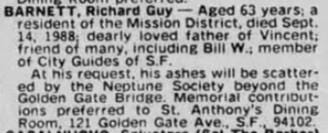
A year later, Richard’s life came to an end. His obituary just three scant sentences. One of which asked for donations to the St. Anthony’s Dining Room that kept him alive through his darkest days. Later that year, after his ashes were spread outside the Golden Gate Bridge, friends, relatives and fellow volunteers with the City Guide program joined together at Golden Gate Park to plant a tree in his memory.
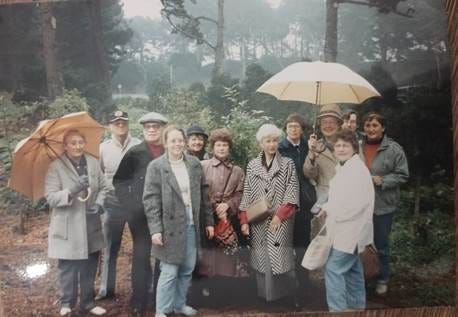
They were honoring a man who took the longest bike trip of all: the one from the peak of fame, through the valley of the shadow, and finally, home.
###
About the Author
I rescue stories from the dustbin of history.
I’m Bill Farley. I’ve published family history articles in American Ancestors, Montana: The Magazine of Western History, and Wild West. I wrote a biography of an Irish millionaire who funded communist newspapers during World War I. My research earned a foreword from a historian with fifty years of experience who called me “the most enterprising and tireless researcher” he’d encountered.
But credentials don’t matter if the stories disappear.
Your family has stories like Richard’s—stories of rise and fall, loss and redemption, ordinary people living extraordinary lives. Stories that deserve more than three sentences in an obituary. Stories that exceed what gets naturally remembered.
This Substack is where I share those stories. Some are from my own family. Some are from the archives I’ve spent years researching. All of them teach you something about how to find, research, and preserve the stories in your own family tree.
Because in two or three generations, most family stories vanish completely. Not because they’re unimportant—but because no one did the work to preserve them.
I’m teaching you how to do that work.
What you’ll find here:
Stories from the dustbin (like Richard’s)—fully researched narratives with artifacts, documents, and photos
Research methods that work—how I found the evidence, connected the dots, solved the mysteries
Behind-the-scenes process—the archives I visited, the dead ends I hit, the breakthroughs that changed everything
Preservation strategies—how to move beyond private family trees to create published work that lasts
Free subscribers get the stories and basic research tips.
Paid subscribers (Coming Soon) get complete access to the research files: full document scans, transcribed letters, correspondence with editors, detailed methodology, and the extended family context that didn’t make the final story.
Subscribe now to make sure you don’t miss the next story from the dustbin.
And if Richard’s story resonates with you—if you have a family member whose life took unexpected turns, whose story deserves to be told—hit reply and tell me about them. I read every response.
—Bill Farley
The Dustbin Historian