
The Man Who Wanted a Bigger Ship
He wrote his official biography for the Sacramento Medical Society in 1969. He wrote letters to my mother for years before that. They are not the same story.

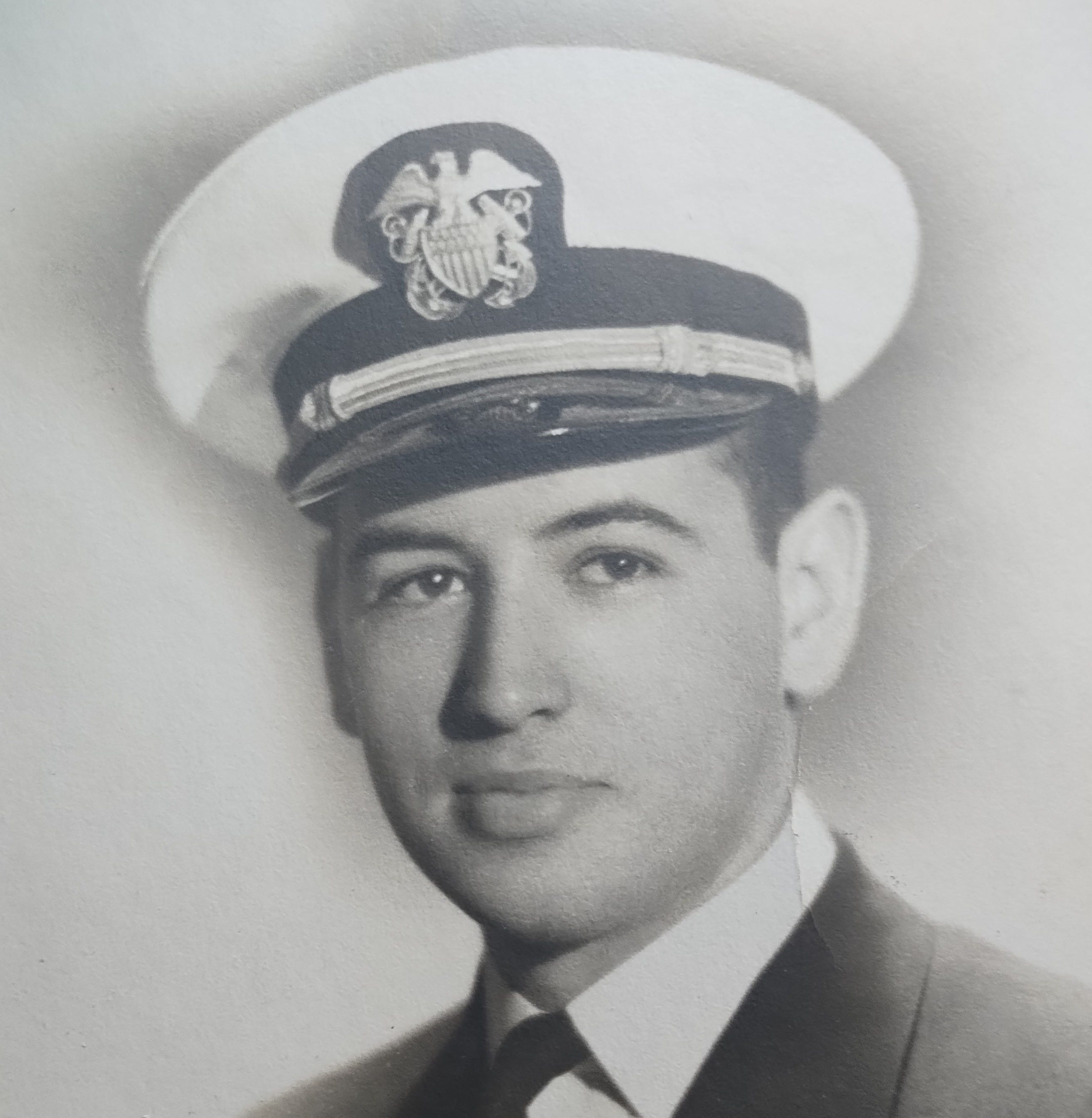
In January 1969, the Sacramento Medical Society published a short profile of its new president, James O. Farley, M.D. The reporter—clearly someone who knew him—opened with a line that tells you everything about the subject: he was too small for the checkers team, so he devoted his spare time to music and the development of charm.
The profile covers his Navy service in the Philippines, his return to Albion College, his medical training at Wayne State, his practice, his partnership with William Hedges, his three sons. It is warm, well-written, and almost completely silent about anything that actually mattered.
My father wrote it himself.
The Official Record
James Owen Farley was born in Detroit in 1925, the son of Sylvia Murray and William John Farley. His parents divorced when Jim was seven. Sylvia remarried to Dr. Nicholas Del Zingro, the town doctor in Davison, Michigan, sixty miles north of Detroit. Dr. Del was a civic fixture, a man who hosted politicians and supported local charities. In Davison, the Del Zingro name meant something. Jim grew up in that household, carrying a different last name than the man who raised him.
Jim graduated from Davison High School in 1942 and enrolled at Albion College as a pre-med student. One year later, the Navy V-12 program sent him to Tufts College in Medford, Massachusetts for officer training, then to Midshipman’s School in Chicago. He received his naval commission in January 1945 and was transferred to the Philippines to take command of an LCT (Landing Craft for Tanks).
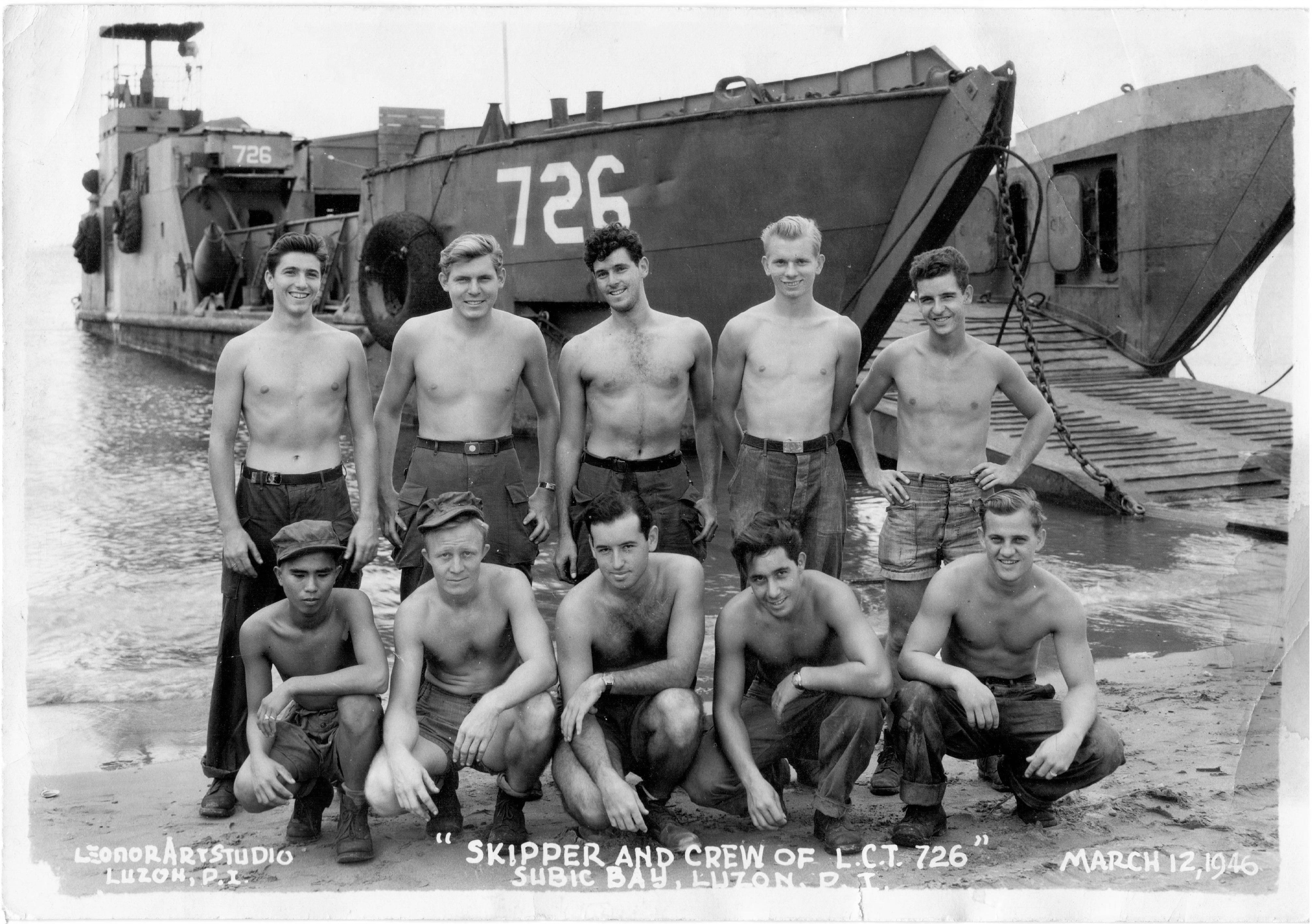
According to the Medical Society profile, he had worked out a plan to evacuate General Douglas MacArthur by PT boat from the Philippines to Australia. The war ended before he could execute it. He was sorry about that.
My father was not a man who overstated things. He was, however, a man who told a story with a straight face that left you unsure whether to believe him. In later years, he mentioned once that after the war ended, he was briefly in charge of the Pacific Fleet. I have looked for documentary evidence of this claim. I have not found it. What I did find, in his naval fitness report dated June 30, 1945, is that Ensign James Owen Farley first served as Executive Officer—second in command—of USS LCT(6) 725, and that under his preference for next duty assignment, he wrote, in his own hand: On board some larger ship.
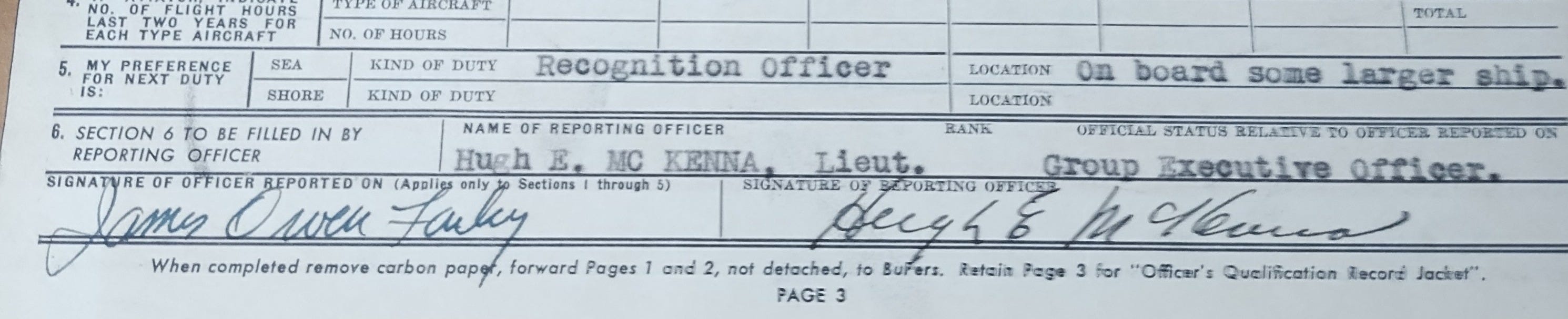
He never got his bigger ship - only a bigger number (726). He went back to Albion instead.
The Library
He returned to Albion College in 1946. He was a junior, back from the war, president of his fraternity. She was a freshman from Detroit named Marlyn Barnett. She was sitting alone in the library.
The Medical Society profile describes what happened next as love at third or fourth sight. That is the official version—and it may be the most honest thing in the entire profile, because it admits that even he couldn’t explain what made him walk across the room.
They dated at Albion for a couple years. Then their lives split geographically. Jim enrolled at Wayne State Medical School in Detroit. Marlyn transferred to the University of Michigan in Ann Arbor. They lived forty-five miles apart and saw each other on weekends when his test schedule allowed. They wrote letters in between. Marlyn kept Jim’s letters.
The letters begin in 1948 after both moved to the Detroit area. They are funny in exactly the way the Medical Society profile is funny—dry, self-deprecating, completely unguarded in a way his official biography is not.
He got four Cs in one semester and celebrated them like a championship: Others can have their As and Bs but I won’t trade my little curved lines for anything. He batted .500 in an intramural softball game and noted that this was better than Ted Williams. In January 1949, he wrote from his room in Detroit: The beautiful lights of the library are shining my way. I’ll have to visit the place one of these days. They say there are a lot of good books over there. He was a medical student staring out the window at the library he should have been studying in, and he made it sound like a travel brochure.
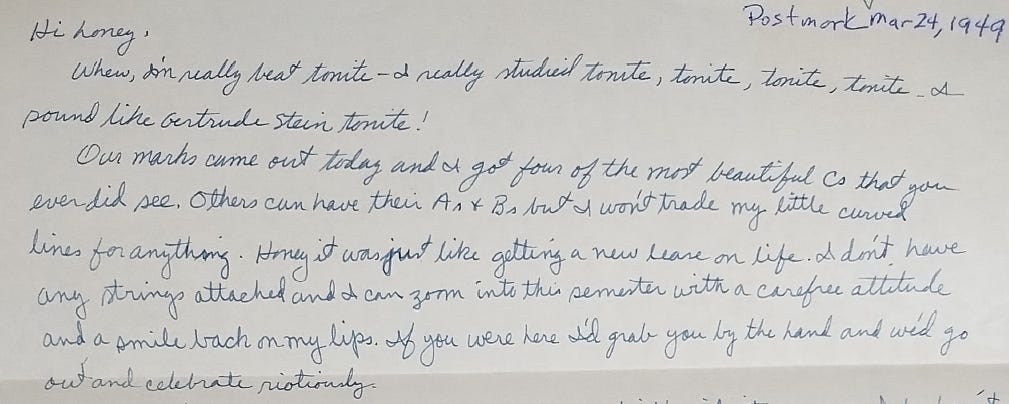
In September 1948, starting his first year, he looked at the contents of his books and considered an alternative career path: Maybe I’d just better call the whole thing off and quietly sneak away to join the French Foreign Legion. Would you write me if I were in the middle of Africa?
A month later, he opened a letter with a cartoon—a small drawing of a man slumped at a desk, a question mark floating over his head, sweat pooling on the floor—and captioned it: What you see in the diagram is the pathetic scene of a man in the state of mental frustration until he is on the verge of complete mental breakdown and collapse. He explained that the experiment had originally been designed to frustrate dogs, but dogs were scarce, so they had switched to freshmen medical students. They frustrate more easily and their bite, while in the “mad” state, does not produce rabies.
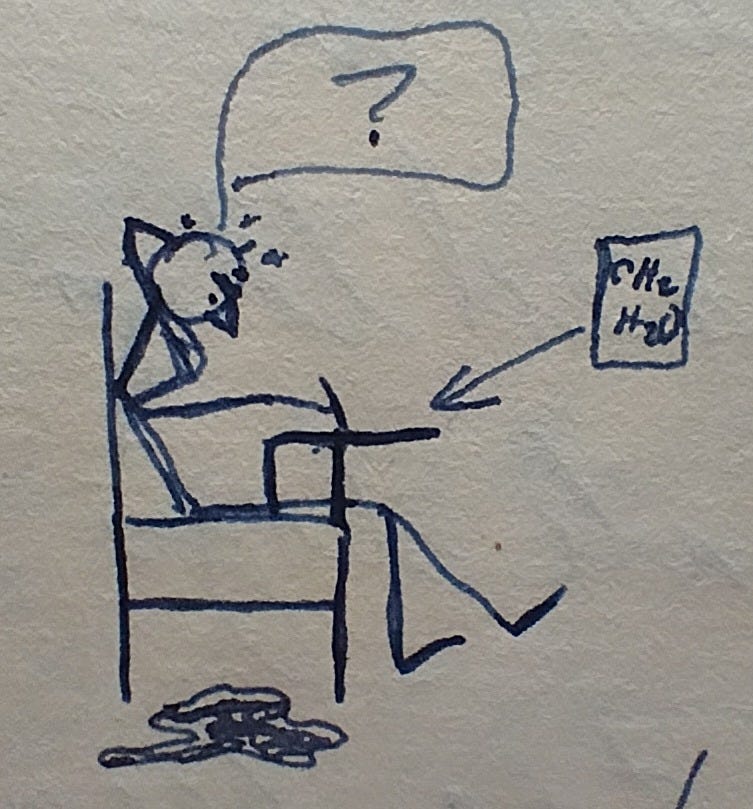
He was, unmistakably, the man who would write about MacArthur twenty years later in a medical newsletter. The voice was already fully formed at twenty-three, writing to a girl he was afraid of losing.
The Problem with No Name
The Medical Society profile mentions that Jim finished his degree, married Marlyn, and headed west to complete his internship at Sacramento County Hospital. Simple. Clean. Westward and forward.
Here is what the profile does not mention.
Jim’s stepfather, Dr. Del Zingro, was a prominent physician in Davison, Michigan. For a new doctor finishing his training, the logical next step was to join an established practice. His stepfather had one. His hometown needed him. He did not take it.
The reason appears in his letters, and unlike most things in his life, he could not find a way to make it funny. In a letter dated August 3, 1948—the earliest in the collection—he writes to Marlyn about a question she had asked him. She wanted to know if he would change his religion for her. He was Catholic. She was Protestant. And his answer is the most Jim Farley sentence in the entire collection: I would hardly call that enough reason. I love you very much and I would change my religion for you—if you loved me.
Then, in the same letter, he catches himself: Aw nuts! Why do I have to go off the beam like that?
This was his pattern. Say the most serious thing he was ever going to say, then wave it off before the ink dried.
By December 1948, the problem had shifted from religion in the abstract to Davison in particular. He wrote: The more I think about it the more I think that you wouldn’t like it in a small town. Everyone is catty, they all know each other’s business. They are all jealous of what their neighbor has. They don’t make friends too easily unless they think it is to their advantage. It’s a rough row to hoe sweet.
He was describing the town where he grew up, the town where his stepfather was the most important man in civic life, the town where he expected to set up practice. And he was telling the woman he loved that she would not survive it. He didn’t say why—not yet. But by March 1949, the weight was showing: I know that our future looks grey but there isn’t any immediate solution to that problem. I just accept that I guess and enjoy being with you. When I’m alone I worry myself with the future but when you’re near the time we have to be together is too short to plug up with the weighty problems.
He would not name the problem plainly for another year. In what reads like a letter he had been composing in his head for two years, he finally wrote it out: Because of the town our differences in religion would be greatly accentuated. I’m not a religious person Marlyn and I would have been perfectly agreeable to any religion you chose but the town knows me as a Catholic. There is an awful lot of friction between the churches in Davison so consequently any change on my part would only add fuel to the gossip fire.
The doctor whose stepfather was the town doctor could not practice medicine in his own hometown. Not because of what he believed, but because of what the town believed about him.
The Releasing Letter
By 1949, Marlyn was finishing at Michigan and beginning a career of her own. Jim was still in school, still in Detroit, still unable to make the kind of commitment that would give her a reason to stay put. And he knew it.
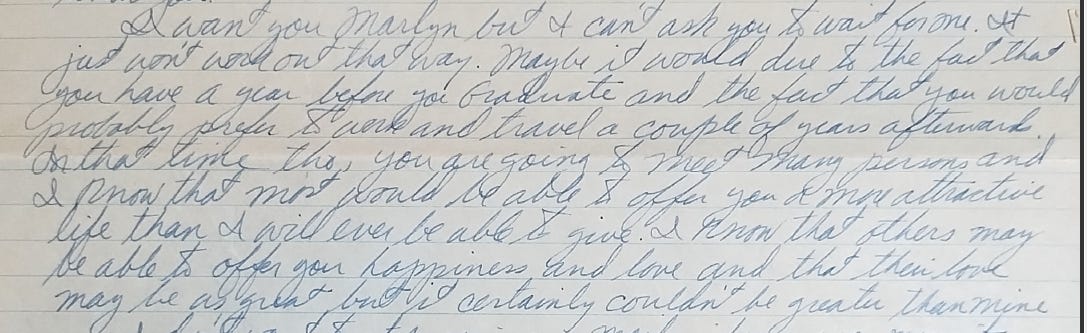
In a letter postmarked May 2, 1949—a Sunday—he wrote her what I think of as the releasing letter. He had just been to church with his uncle’s family. They were, he wrote, pretty strongly Catholic. He sat in the pew and tried to talk himself into believing it mattered. He could not. He wrote: I love you very much and if it were possible to marry you as soon as possible I would change my religion for you and promise to never bring the point up again. You mean more to me. My ideas on salvation and the like do not require a specific religion.
Then the letter turns. He shifts from the religion problem to the problem underneath it—the one he had been circling for three years. He tells her what he thinks is going to happen:
I want you Marlyn but I can’t ask you to wait for me. It just won’t work out that way. Maybe it would due to the fact that you have a year before you graduate and the fact that you would probably prefer to work and travel a couple of years afterward. In that time you are going to meet many persons and I know that most would be able to offer you a more attractive life than I will ever be able to give.
He tells her that others may be able to offer her happiness and love, and that their love may be as great—but it certainly couldn’t be greater than mine.
He tells her he does not want to stop seeing her, and that it is precisely because she means so much to him that he will ask her to go out with others. Then he says the thing he had been trying to say for three years without ever quite managing it: I once asked you to let me love you without your loving me in return.
This letter is a mess and so am I.
He signs it: all my love, Jim.
The Bald Head
He walked it back.
In a subsequent letter—postmarked May 8, 1949—he writes: Gosh I felt good after talking to you last nite. Your voice sounded wonderful honey. He tells her he has been kicking himself for being so stupid. He agrees with her: life is too short to work all these complications into it.
And then, in a short note that may have been enclosed with the same letter or sent days later, he asks to be taken back:
You’re right honey, this situation is strictly for the birds! I do love you very much and I think that that is the most important thing to consider. If you will forgive me I would like you to take back this slightly used and beat up contraption with a bald head called me. I’m sure that everything will work out and that there isn’t any real problem at all. I did make you a promise and I had no right in the world to change it so I ask you to let me turn back the clock and make that correction.
He was twenty-four years old. He was bald. He thought he was losing her. And the way he asked to be taken back was to describe himself as a slightly used and beat-up contraption.
She kept that letter for sixty years.
The Wedding
Jim and Marlyn married in June 1952, the same month he finished medical school. They traveled to Sacramento, California, where he completed his internship at Sacramento County Hospital and eventually formed a practice with William Hedges, M.D. They were still at the same location twenty-two years later, according to the Medical Society profile. Jim and Marlyn had three sons. Then a fourth.
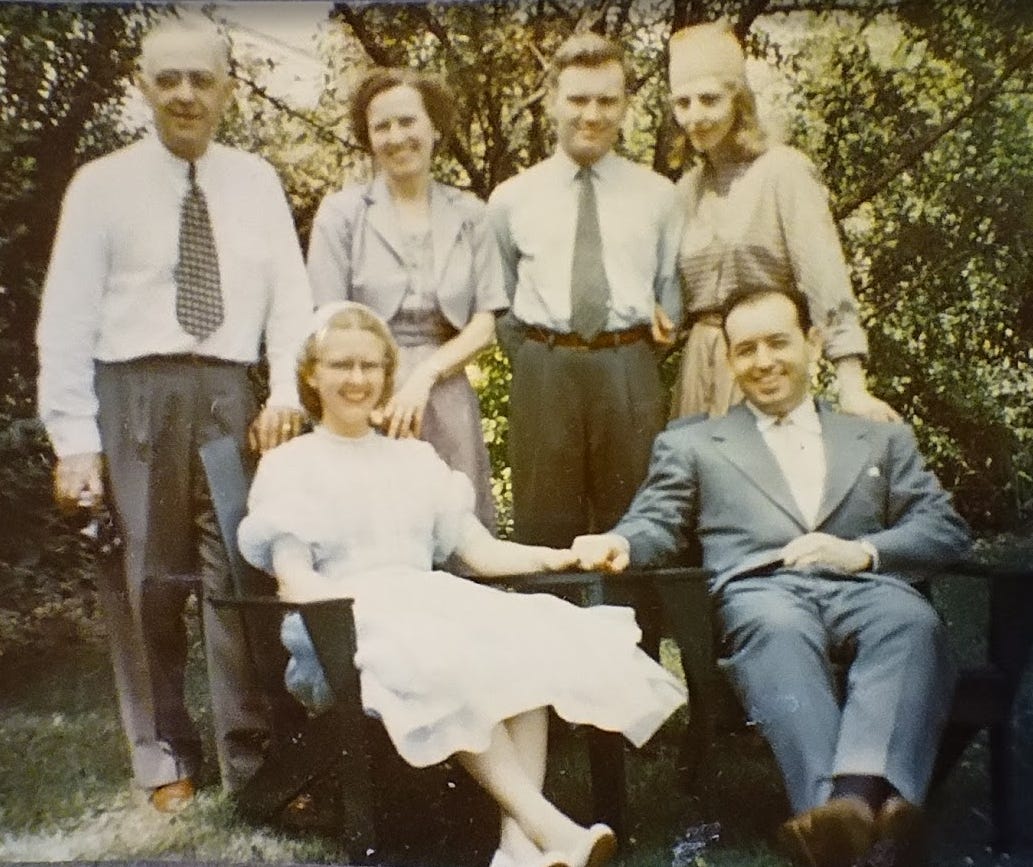
The wedding photographs show the Barnett side of the family. Marlyn’s parents, her father Guy, her mother Esther her brother Richard and his wife Elizabeth. From Jim’s side of the family: no one.
No relatives came from Davison. Not for the wedding, and not after. I never met my grandmother Sylvia. She never came to Sacramento. She never sent a card. She never, in any way I’m aware of, acknowledged that her four grandchildren existed.
What the Record Shows
The official record—the Medical Society profile, the obituary, the civic honors—shows a man who built a good life, served his patients, raised four sons, and retired from medicine in Sacramento. All of that is true.
What the letters show is the man who made the official record possible. The man who understood that the town he grew up in would not let him stay, and made his peace with that in writing, alone, and mostly without saying it plainly even to the woman he was writing to. The man who sat in a Catholic church with his uncle’s family and tried to talk himself into believing it mattered and could not. The man who told Marlyn she should probably find someone better and then asked, a week later, to be taken back—describing himself as a slightly used and beat up contraption with a bald head.
He was not an eloquent man in the conventional sense. He did not write long declarations. He told jokes when he meant something serious, and he meant something serious most of the time. In a letter postmarked December 13, 1948, he wrote: I love you so very much that I’m at a loss to tell you. I have to leave it that way for now honey. Maybe some day I can tell you in an eloquent manner but tonite I’m all fogged up.
The letters stopped, eventually. The practice started. The family grew.
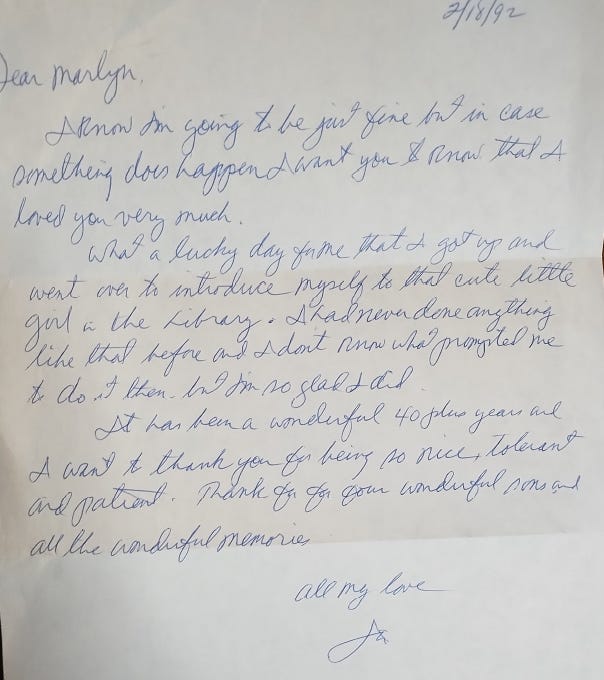
In the 1980s, before heart surgery, he wrote Marlyn another note. I have it. He told her how lucky he was that he got up one day and walked over to introduce himself to that cute little girl at the library. He said he had never done anything like that before and didn’t know what prompted him to do it then.
He thanked her for being so nice, tolerant, and patient.
He knew exactly what he was thanking her for. He just couldn’t say it plainly, even then.
The Last Date
My mom developed Alzheimer’s disease in her final years and needed 24 hour care. My father, now 87, cared for her until leukemia sapped his strength. While he was in a convalescent hospital recovering from a setback, we placed mom in a residential care home. He looked at his sons and said: you did what I couldn’t.
That was the same voice. Six words to carry everything he meant—thank you, and I’m sorry, and I know this was hard. The man who waved off a declaration of love with “Aw nuts” was never going to deliver a speech. He was going to find six words and let them do the work of sixty.
One week before he died, we arranged for my parents to have a last visit. When my mother entered his room, she said: There’s the one. She gave him a kiss on the cheek. They spent twenty minutes alone together. As she left, she stepped back to give his hand a kiss. Later that day, she mentioned him by name for the first time in many months.
He sent her a box of See’s candy the next day with a note:
Hi Marlyn. Have some sweet candy for a sweet girl. It was nice seeing you yesterday. Love—Jim.
The man who wrote I’m at a loss to tell you in December 1948 was still writing the same way sixty-four years later. Small gestures. Oblique language. It was nice seeing you yesterday.
He had loved her since before she knew what love was. He said so once, in a letter, and then he never said it quite so plainly again.
He didn’t have to. She kept every letter.
What He Meant
My father thanked my mother, in that note before heart surgery, for being nice, tolerant, and patient. Those are the words he chose. Nice. Tolerant. Patient.
Here is what he meant.
He meant: you were twenty years old and you sat in a library in Albion, Michigan, and a bald junior walked over and introduced himself, and for reasons neither of you could explain, you said yes. He meant: I asked you to wait for me through four years of medical school and you did, even when I told you not to. He meant: the town I grew up in would not let me bring you home, and you never made me feel guilty about that. He meant: I left behind my family, my stepfather’s practice, and everything familiar, and you came with me to Sacramento without looking back. He meant: my own mother never acknowledged our children, and you carried that weight without asking me to explain it. He meant: I spent my whole life unable to say any of this plainly, and you never needed me to.
He meant all of that. He wrote nice, tolerant, and patient.
I have spent thirty years in archives, reading the letters and documents of people who are no longer here to explain themselves. Most of the time, my job is to figure out what happened. Occasionally, my job is to figure out what someone meant. And every once in a while, my job is to say the thing that the person I’m researching could never quite manage to say out loud.
This is one of those times.
My father loved my mother completely, from the moment he walked across the library until the box of See’s candy arrived the day before he died. He loved her through four years of letters, a religion problem he couldn’t solve, a town that wouldn’t have them, and a cross-country move that cut him off from everyone he knew. He loved her in the only language he had, which was jokes, deflections, and small gestures that meant more than he would ever say.
She knew. She always knew. She just let him say it his way.
Every family has an official version—the obituary, the résumé, the story that gets repeated at Thanksgiving until nobody questions it. And every family has a box somewhere. A drawer. A closet shelf. A stack of papers nobody has looked at because the person who wrote them is gone, and the person who saved them is gone, and nobody who’s left knows what’s inside.
Open the box.
P.S. Next time I’m returning to Montana. I have been sitting on the story of James A. Murray’s nephew—a man his uncle put through law school, who spent thirty years in the United States Senate and once rode with Franklin Roosevelt to the Fort Peck Dam. Senator James E. Murray cast a long shadow. Stay tuned.
P.P.S. This post was built from fourteen handwritten letters, a naval fitness report, a Medical Society newsletter, a wedding photograph, a note written before heart surgery, and a box of See’s candy. None of them were in an archive. All of them were in a house. If you want to know how those pieces fit together into a story, that’s a future post.
You have a wonderful ability to see the story hidden in the outlines of the pieces of paper in front of you. What is especially moving about this piece is the fact that I think there are a lot of love stories out there like this, especially from that generation. As we look at the lives of other people, it is so easy to judge them based on our own biases or expectations, but as your story points out, you need to look at someone's life based on how they saw it in order to come closer to the truth and to understand the choices people make. Your piece points the way for other people to perhaps reinvestigate the stories of their family to see them more clearly. Great job!
Oh Bill, this is beautifully written! Your parents' story is beautiful and touches my soul in a deep and holy place! Thank-you so much for sharing it! Jeanie