
The Murder in Room 720
Part 1: What the Family Didn’t Know about Mary Grace Farley

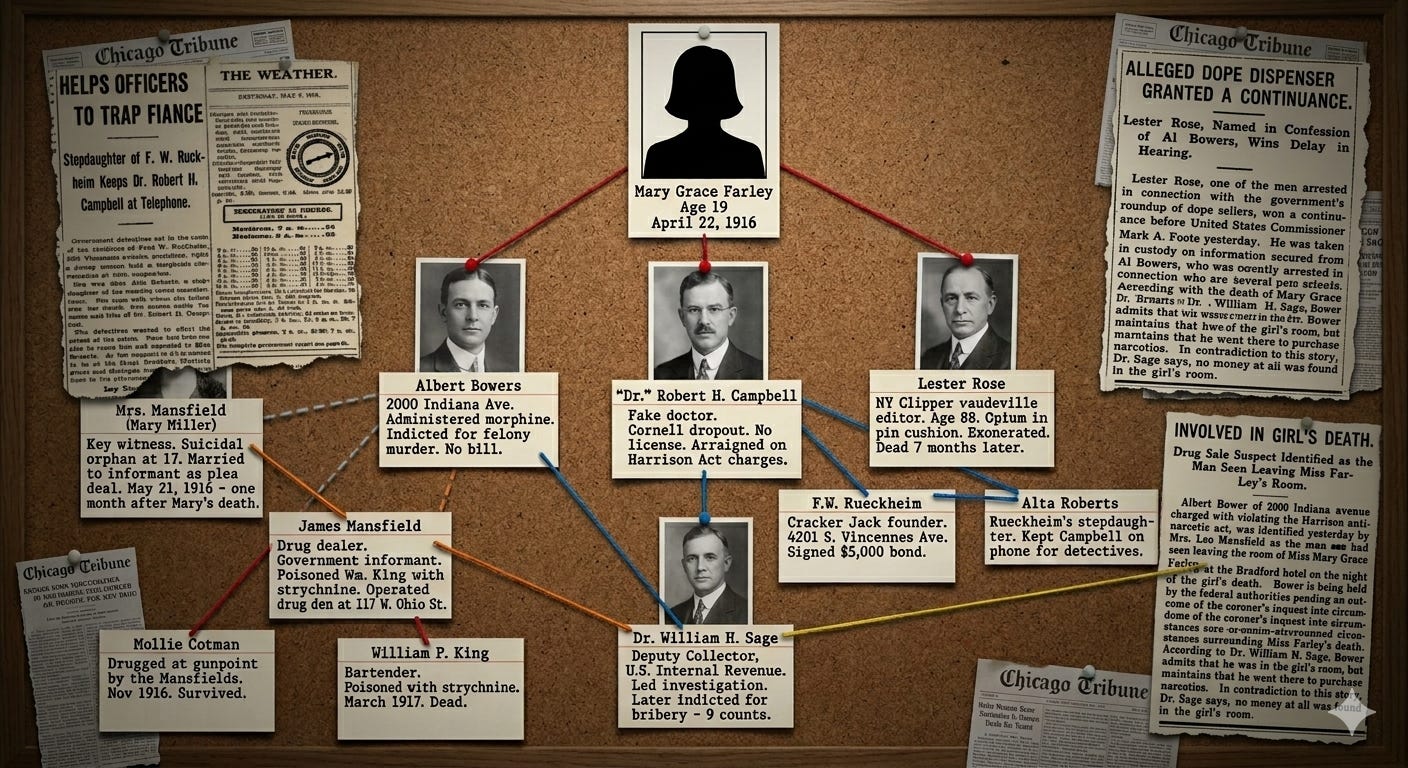
I recently discovered my grandaunt, Mary Grace Farley, was murdered in Chicago in 1916, that the investigation led to the founder of Cracker Jack, and that no one in the family thought to mention it for nearly a hundred years.
—
My father, James Owen Farley, M.D., was a meticulous man. He kept letters, fitness reports, and fraternity beanies. When he wanted to know about the Farley side of the family, he wrote to his aunts in Michigan. They wrote back on Hummel stationery. They told him stories about the Murrays, about Montana, about the old days. They did not mention his Aunt Mary.
Not once.
My grandfather, William John Farley, was a plumber in Chicago. His father, Lawrence, was a teamster. His mother was Ellen Mead. They were second-generation Irish, born in Cook County—not recent arrivals scraping by in a new country, but a family with roots. William had a sister named Mary Grace Farley. She was born on February 20, 1897.
She died on April 22, 1916, in Room 720 of the New Bradford Hotel, 3000 Michigan Avenue, Chicago. She was nineteen years, three months, and three days old. Her occupation was listed as waitress. Her marital status was single.
She was not registered under her own name.
—
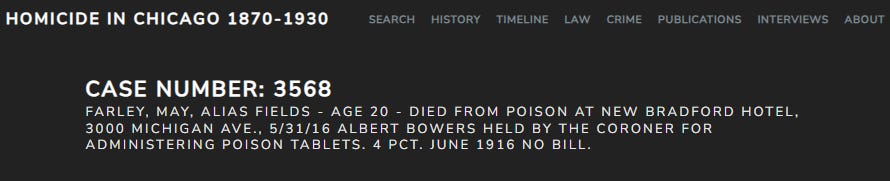
I found Mary the way I find most of my relatives—by typing names into databases at odd hours and following whatever thread the search engines give back. She first appeared to me in the Northwestern University database titled “Homicide in Chicago 1870-1930.” She was one of two relatives in that database.
With a death date I turned to the Cook County Deaths Index, 1878–1922, and it returned a clean hit: Mary Grace Farley, born February 20, 1897, died April 22, 1916. Father, Lawrence P. Farley. Mother, Ellen Mead. Cemetery, Mt. Olivet. Buried April 24, 1916.
Two days. They buried her two days after she died.
Then I searched the newspapers. And the Chicago Tribune had quite a lot to say.
—
But before the Tribune said anything, the Day Book had already told the story—twice, on the day Mary died.
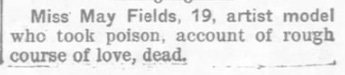
The first item was a single line in the paper’s daily roundup: “Miss May Fields, 19, artist model who took poison, account of rough course of love, dead.”
The second was a police blotter entry: “May Fields, Bradford hotel, 30th and Michigan av., found in dazed condition. Dying. Police suspect quantity of opium.”
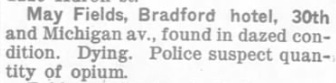
Artist model. Poison. Rough course of love. That was the story on April 22, 1916. A girl who killed herself over a man. The kind of item that fills a column inch and is forgotten by the next edition.
It took two weeks for the story to change.
—
On May 6, 1916, the Tribune ran a headline: “HELPS OFFICERS TO TRAP FIANCE.” The subhead read: “Stepdaughter of F. W. Rueckheim Keeps Dr. Robert H. Campbell at Telephone.”
The article described a scene at 4201 Vincennes Avenue—the home of Frederick W. Rueckheim, founder of the Cracker Jack Company. Government detectives had been trying to arrest a man using the name and title of Dr. Robert H. Campbell. They couldn’t reach him. So they appealed to Miss Alta Roberts, Rueckheim’s stepdaughter, who was described as Campbell’s fiancée. At their suggestion, she called Campbell and arranged for him to come to the Hotel Bradford at a stated hour. The detectives were waiting.
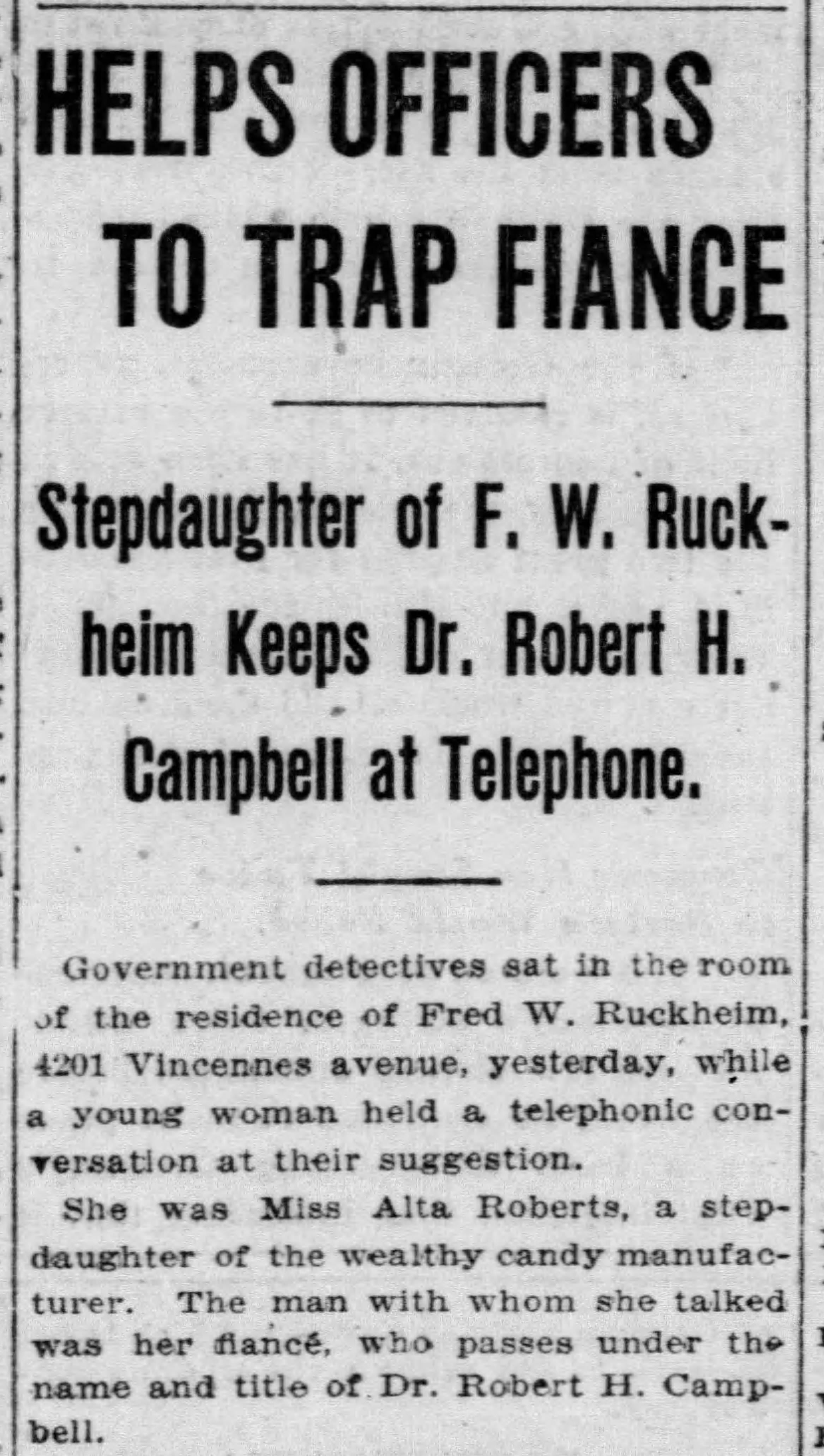
Campbell drove up in an automobile. He was prepared to leave the city in a hurry. The officers told him he was under arrest in connection with the death of May Fields.
May Fields, the Tribune explained, was registered at the Bradford Hotel. Her real name was Mary Grace Farley. She had died at Michael Reese Hospital from morphine poisoning.
—
The articles kept coming.
On May 7, Campbell was turned over to federal officers and arraigned before Commissioner Foote on charges of violating the Harrison anti-narcotic act—a federal law barely two years old. Campbell denied ever hearing of May Fields. He said he had been framed. He threatened to expose prominent physicians.
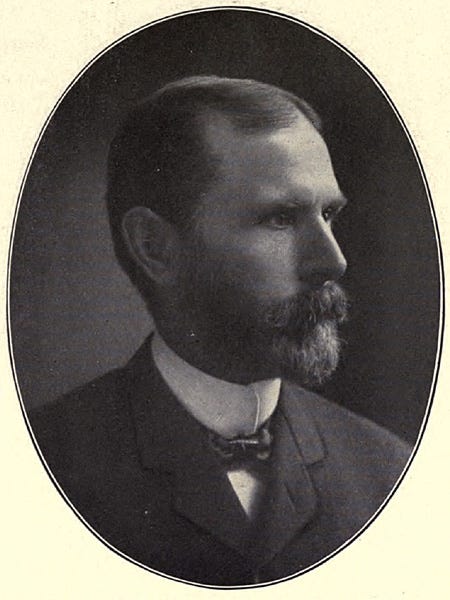
Then the Tribune reported something remarkable. Fred W. Rueckheim—the candy manufacturer, the Cracker Jack founder, one of the wealthiest industrialists in Chicago—signed Campbell’s five-thousand-dollar bond. He told the press he would assist in exposing prominent physicians.
The man arrested in connection with my grandaunt’s death had his bail posted by the man who invented Cracker Jack.
—
Campbell was a fraud. He had studied at Cornell but never graduated, never obtained a medical license. Until recently he had worked as an assistant to Dr. F. J. Port, house physician at the Auditorium. Port told reporters he’d fired Campbell because Campbell had talked about illegal operations.
But Campbell wasn’t the only man connected to Mary’s death. On May 9, the Tribune reported that Albert Bower of 2000 Indiana Avenue—charged with violating the Harrison act—had been identified by a Mrs. Leo Mansfield as the man she’d seen leaving Mary’s room at the Bradford Hotel on the night of her death.
According to Dr. William H. Sage, the deputy collector of United States internal revenue running the federal drug investigation, Bower admitted he was in the girl’s room. He claimed he had gone there to purchase narcotics. Dr. Sage noted that no money was found in the room.
Then came Lester Rose.
—
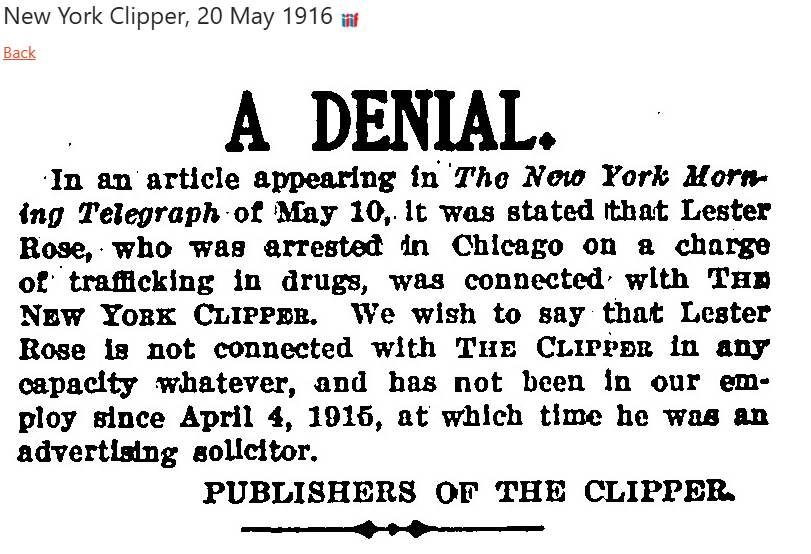
Rose was the editor of the vaudeville and burlesque department at the New York Clipper, one of the leading theatrical trade publications in the country. On May 18, the Tribune reported that Rose had been arrested as an accessory to the murder of May Grace Farley, whose death at the New Bradford Hotel resulted from an overdose of narcotics.
Rose admitted he had called to see Mary the night before she was found dead. His explanation: she had telephoned him about some pictures that were to be used in the New York Clipper.
Hotel attachés confirmed that Rose and Bower came together and were seen leaving Mary’s room. Rose was being held at the Wheaton jail on a Harrison Act charge. He refused to give testimony.
Federal agents, led by Dr. Sage, raided Rose’s room at the Warner Hotel on Thirty-ninth Street and Cottage Grove Avenue. They found a jar of cooking opium concealed in a pin cushion.
The Tribune noted that Mary’s death had created a sensation because federal authorities were in the midst of an investigation of a south side “dope ring.”
The next day, May 19, the Tribune ran a brief correction also published in the New York Clipper. Casper Nathan, western manager for the New York Clipper, requested that the paper note Rose was no longer employed by the Clipper. Rose died seven months later, on December 3, 1916.
—
On June 1, a coroner’s jury ruled. Albert Bower was ordered held for the grand jury. The verdict specified no formal charge, but recommended he be held for the death until released by due process of law. Lester Rose was exonerated at a reopened inquest.
The verdict ended an investigation of more than a month by the police, the coroner’s office, and the federal government.
But the coroner had already written his conclusion.
—
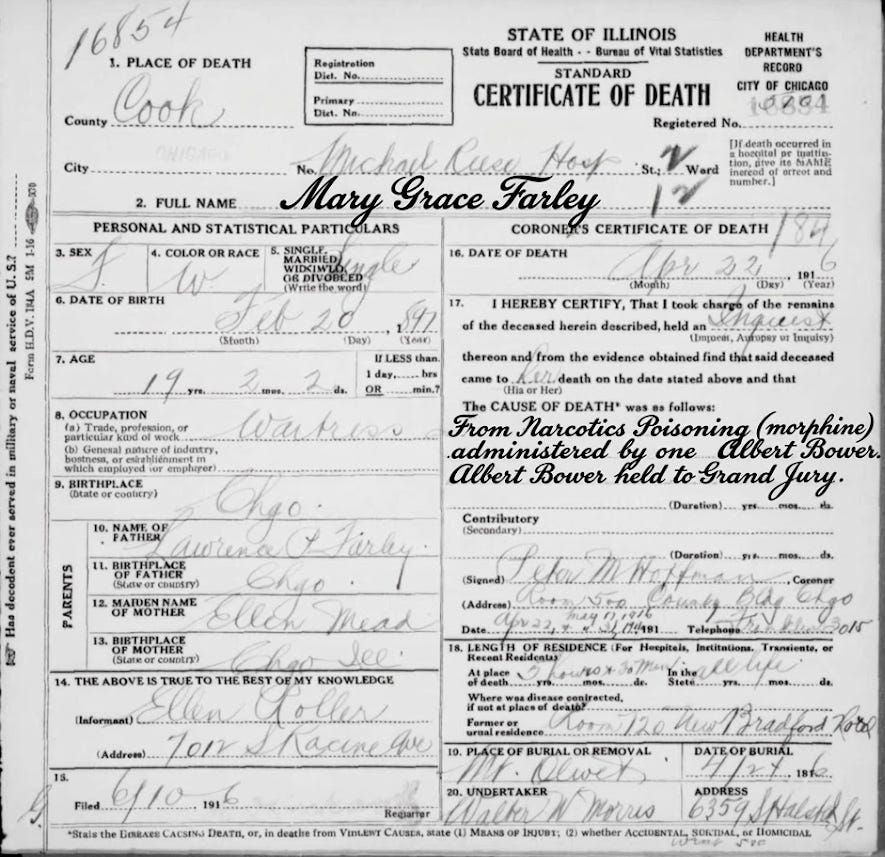
The State of Illinois Standard Certificate of Death for Mary Grace Farley is not ambiguous. Under the coroner’s certification, Section 17, the cause of death reads: “From Narcotic Poisoning (Morphine). Administered by one Albert Bowers. Held to Grand Jury.”
Not an overdose. Not self-administered. Not accidental. Not a rough course of love. The coroner wrote that Albert Bowers administered the lethal dose of morphine to a nineteen-year-old girl, and he put it on the official state record. This is the last honest document in the case. Everything that followed—the inquest, the grand jury, the collapsed indictment—was the system backing away from what the coroner already wrote down.
The Northwestern University Homicide in Chicago database confirms the rest. Case Number 3568: Farley, May, alias Fields. Type of death: Manslaughter. The grand jury convened on June 1, 1916, and returned an indictment for felony murder.
And then: no bill. No charges recorded.
A grand jury indicted a man for felony murder in the death of a nineteen-year-old girl—a man the coroner had already named on the death certificate as the person who administered the fatal dose—and the case simply stopped. Bowers walked. Rose walked. Campbell had the Cracker Jack founder posting his bail.
The only person who didn’t walk away was Mary.
—
The death certificate holds one more detail. Section 14 lists the informant—the person who provided the biographical information about the deceased. It is Mary’s mother.
She signed the form as Nellie Roller, with an address at 7017 South Racine Avenue. Ellen (Mead) Farley had remarried. She was living under a different name, on the far South Side, miles from the Bradford Hotel. And when her nineteen-year-old daughter died in a narcotics scandal that was about to fill the Tribune for weeks, Nellie walked into the coroner’s office and said: this is my daughter, and here is who she was.
She gave them Mary’s parents’ names, her birthdate, her occupation. She signed the form and swore the contents were true. She is the last person who officially acknowledged Mary Grace Farley before the silence began.
—
There is one more piece.
In March 1915—a year before Mary’s death—a newspaper in Champaign-Urbana ran an advertisement for the Orpheum Theatre. It featured a photograph of a performer, with the caption: “Miss May Fields of Winter & Fields. Orpheum Monday for three days.”
May Fields was a real person—or at least a real stage name—working the vaudeville circuit. And Lester Rose, the man who admitted visiting Mary the night before she died, was was employed by the New York Clipper for a time. He said she called him about pictures for the paper.
Mary rented a room in the New Bradford Hotel under the name of a vaudeville act. A vaudeville publisher was in her room. Her death certificate says waitress.
I don’t know whether Mary was part of Winter & Fields, or whether she borrowed the name of someone she’d seen on a handbill, or whether the alias was given to her by someone in that world. What I know is that a nineteen-year-old girl from a teamster’s family was living in Room 720 of a hotel near the City’s entertainment district (outside the red light district) under someone else’s name, and that the people who came to see her included a fake doctor, a drug dealer, and a “theatrical press agent” with opium in his pin cushion.
—
The family buried Mary at Mt. Olivet Catholic Cemetery, Section 25, Lot 106. They buried her two days after she died—before the Tribune had published a single article about the investigation. They got her into consecrated ground next to her maternal grandparents while the coroner’s office was still figuring out what happened in Room 720.
There is no grave marker.
Nellie outlived her daughter by twenty-six years. She spent her final years at the Chicago State Hospital. When she died in 1942, she was buried at Mt. Olivet—the same cemetery as Mary, but not the same plot. She was interred under the name Nellie Roller. A different name than the one her daughter was born with. A different piece of ground than the one her daughter lies in.
Nellie is the only person in this story who showed up for Mary. She claimed the body. She gave the coroner her daughter’s real name. She buried her in two days, in consecrated ground. And then the story broke her, too.
A volunteer genealogist named William Kazupski eventually added Mary’s name to Find A Grave. A stranger did the work the family wouldn’t—put her name in a place where someone could find it. That’s how I know where she is. A hundred years of silence, broken by a man who never met her, typing into a website.
—
My father didn’t know Mary existed. His aunts from the Murray side—Margaret and Fern—never mentioned her, but they married into the family after the fact. They wouldn’t have known. The family’s silence was not an accident or a lapse. It was a project. And it worked for a hundred years.
It stopped working when I started typing names into databases.
—
There is more to this story than a family never knew.
The federal agent who led the investigation into Mary’s death—Dr. William H. Sage—was later indicted for taking bribes to suppress drug cases. The key witness who placed Bowers at the scene was not an innocent bystander. The south side dope ring that the Tribune mentioned in passing was a network that consumed other young women before and after Mary. The coroner wrote the truth on the death certificate, and then a system of corrupt officials, compromised witnesses, and complicit silence made sure it didn’t matter.
I’m going to Chicago to find out what that system looked like from the inside.
—
This is Part 1.
I’m going to the Cook County archives to look for the coroner’s inquest testimony—to find out if Nellie walked into that hearing and spoke for her daughter, or if Mary died without anyone from her family on the record. I’m going to look for the criminal court file on Bowers’ felony murder indictment—to find out what made a grand jury’s true bill evaporate into nothing. I’m going to the National Archives to see if the federal Harrison Act cases against Campbell, Bowers, and Rose left any trace, and whether the corruption that protected them left a paper trail.
And I’m going to Mt. Olivet Cemetery, Section 25, Lot 106, to visit the grave of a grandaunt I never knew I had.
Part 2 will be whatever I find.