
The Night Sacramento Kept Its NBA Team
29 years ago tonight, Sacramento voted 5-3 to save an NBA franchise. Five weeks later, I resigned.

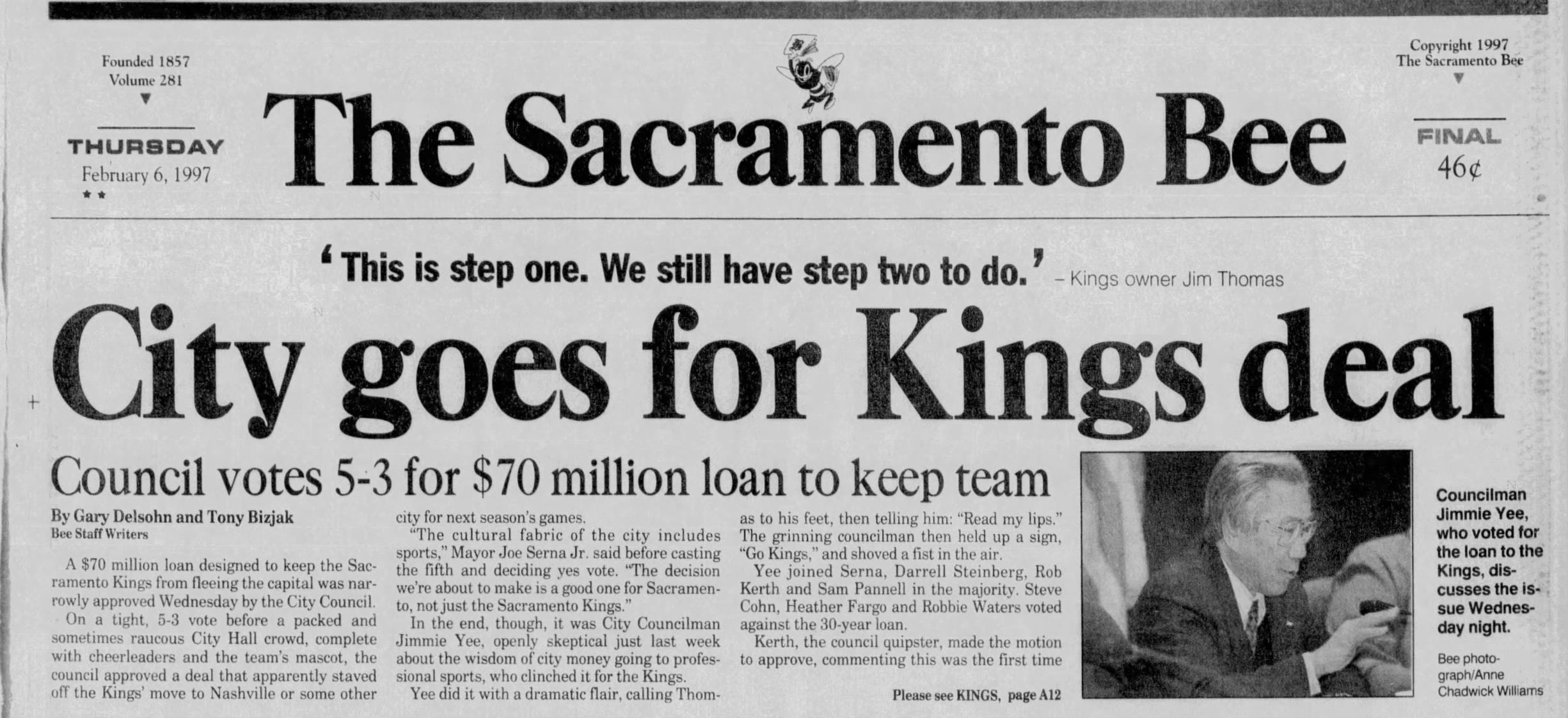
29 years ago tonight—on my 38th birthday—I stood before the Sacramento City Council and presented a $90 million deal to keep the NBA Kings in town.
The vote was 5-3. The Los Angeles Times called it “draconian”—a compliment in my book. A local columnist said I played “bad cop” to the City Treasurer’s cheerleader, “clucking dubiously” through my presentation like a man who wasn’t comfortable “selling a deal.” My comfort zone was being a skeptic.
Five weeks later, I submitted my resignation. My position was about to be eliminated—part of a “bureaucracy shake-up” the Sacramento Bee predicted would begin “at the top.” Another compliment? I was a middle manager buried in the depth chart. Nevertheless, the Office of Economic Development I’d built over five years was being dismantled. My resignation letter landed in the archives of the California State Library.
The irony wasn’t lost on me then. It still isn’t.
I’ve spent the last year in several local archives—over 100 boxes of material from Mayor Serna, his chief of staff, his speechwriter, even his political rivals—piecing together how Serna accomplished what seemed impossible in Sacramento’s weak-mayor system. And why it all fell apart.
The Kings deal was the last major transaction of that era. The vote happened on February 5, 1997. By summer, the institutional capacity that made deals like this possible had walked out the door.
I was a small part of that capacity. I didn’t fully understand it at the time. Twenty-nine years later, I think I finally do.
The Room That Night
Mayor Serna called the special meeting to order at 7:00 p.m. in the Council Chamber at 915 I Street. Every seat on the dais was filled—Councilmembers Cohn, Fargo, Kerth, Pannell, Steinberg, Waters, Yee, and the Mayor himself. No absences. This was not a night to miss.
The Mayor thanked everyone who had attended the previous evening’s public hearing—”both for and against”—and then thanked the staff “who had given many hours of dedication and effort into this project, stating that the Council realized it was a tough issue but appreciated the expertise of those involved.”
I was one of those staff members. My title was Economic Development Manager. My job that night was to present the business terms of a deal that would refinance $90 million in debt on Arco Arena and the Kings, keeping Sacramento’s only major league franchise from leaving town.
The Special Committee appointed to review the Kings’ finances had already delivered their verdict. Henry Royer, a CPA with a reputation for fierce independence, chaired the group. Their conclusion: “There is a definite need in the near term for debt restructuring.” The owners had taken no distributions. All cash had gone back into operations. On a combined basis, the Kings and Arena had posted an economic loss in the most recent fiscal year.
The committee also delivered a warning: “The primary risk to the city in this transaction is the risk that Arena revenues will not grow sufficiently to repay the debt over the next 30 years.” The loan never made it to term. It was paid in full by early 2019.

The Opposition
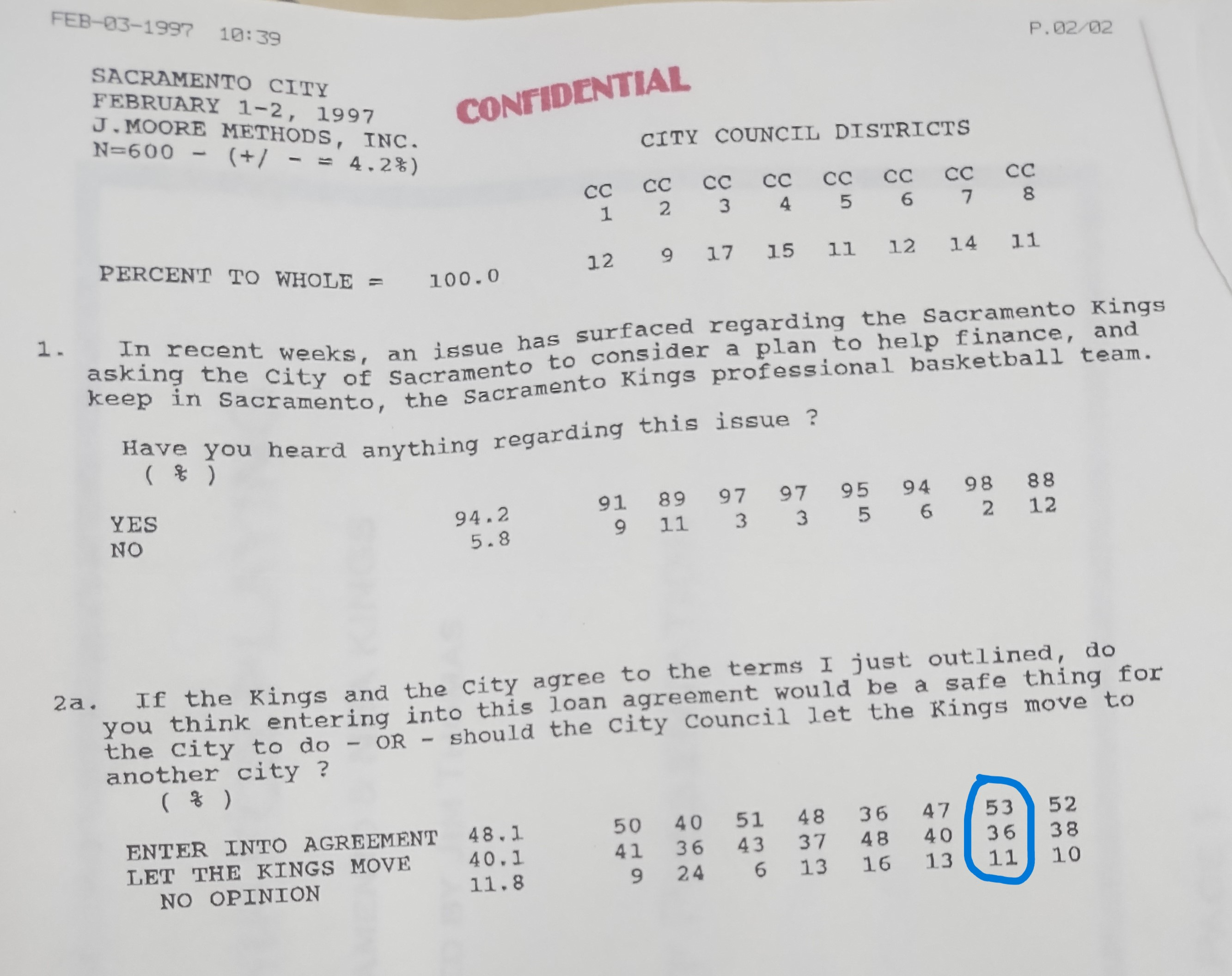
Councilman Waters had heard from his constituents. Over 500 calls, he reported. Ninety-five percent opposed. Serna remained quiet. (What I learned from my archival search is that Serna had commissioned a poll of every council district on the deal. Water’s district seven came in with 53% support and 36% opposed - the most support of any council district.)
“The City is not in business to support professional sports,” Water said. “There is a great need for police officers and many other things around the City that are of major concern.”
He wasn’t wrong.
Councilwoman Fargo, who had served on the Working Group, announced she would vote no. “Too risky and not good for the City,” she said. The timing was “way too rushed.” The NBA had “a small media market.”
Councilman Cohn praised the staff’s work—”the Working Group and staff have put together the very best deal that could possibly be done”—but said he couldn’t support it. The bonds were backed by the full faith of the general fund. Jim Thomas couldn’t back the risk personally. “Without putting this question to a vote,” Cohn warned, “the ‘well’ was poisoned for future professional sports.”
He was voting no.
That made three.
“It does for now”
The moment I remember most clearly came when Mayor Serna asked Jim Thomas directly: Would this deal keep the Kings in Sacramento?
Thomas’s answer: “It does for now.”
Not exactly a ringing endorsement. But it was honest. Thomas explained he was the managing partner, not the sole owner. His presence that evening was “representative of the other owners and employees.” The deal was contingent on resolving a signage agreement. Nothing was guaranteed.
The Special Committee had already noted the uncomfortable truth: “The Committee is convinced that the owners economically could do better by selling and letting the franchise move.”
The Kings stayed because Jim Thomas wanted them to stay. The city’s job was to make staying financially viable. That’s what we did.
The Vote
Councilman Steinberg (and future mayor) gave the longest closing statement. He’d spent three weeks “probing and searching all sides.” He acknowledged the criticism—the rushed timeline, the escalating NBA salaries, the $90 million that opponents called a “subsidy” but he called a “secured collateral loan.”
Councilman Pannell quoted from a Bee editorial recommending the deal. Councilman Yee thanked me by name for “the time and clarification” I’d provided—then in dramatic flourish. “Read my lips,” he told the crowd. “Go Kings.” He held up a fist in the air. The room erupted.
Serna closed the discussion with few words. That meant he had the votes. The motion came from Kerth, seconded by Steinberg.
The vote: 5-3. Cohn, Fargo, and Waters dissenting.
The meeting adjourned at 10:25 p.m.
Why It Matters Now
I spent most of last summer at the archives—primarily at CSU Sacramento, where Serna’s papers are housed. Over 100 boxes of memoranda, strategy documents, unsent letters, and handwritten notes.
One afternoon, I asked the student workers who retrieved the boxes if they knew who Joe Serna was.
They did not. They knew his name was attached to a plaza on campus. They didn’t know he’d been Sacramento’s mayor.
Twenty-five years after his death, the monuments remain—a plaza, a building, occasional commemorations—but the memory of what he actually accomplished is dissipating. The students pulling his boxes from the shelves had no idea they were handling the papers of a man who reshaped their city.
That’s why I’ve spent the last year trying to understand what happened. Not just to me, but to the entire apparatus that made Sacramento punch above its weight in the 1990s.
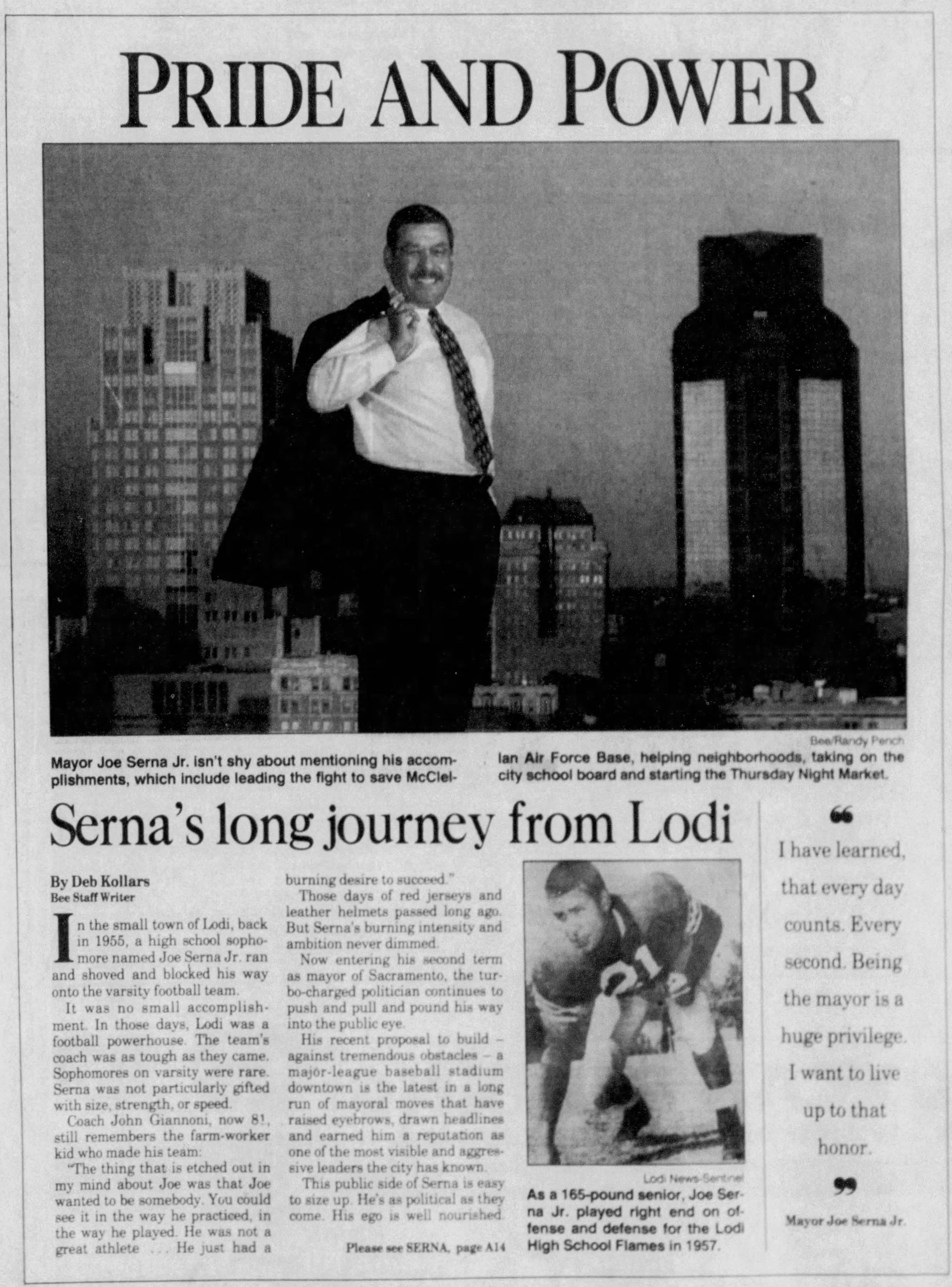
Mayor Serna had no formal power. The Sacramento City Charter gave him exactly one job: preside over council meetings. He couldn’t hire or fire the city manager. He couldn’t veto legislation. He was one vote out of nine.
And yet, between 1992 and 1999, Serna reshaped the city’s skyline, led a gold-standard military base conversion, retained major corporations and an NBA franchise, and advanced school board reforms—all while serving part-time.
How?
The answer, I’ve come to believe, lies in something I’m calling “co-located capital”—expertise and networks embodied in key staff who bridged the political and administrative worlds. People like Deputy City Managers David Martinez and Bob Thomas. SHRA Executive Director John Molloy. Chief of Staff Michael Picker.
When many left—Thomas to the County, Molloy to Los Angeles, Picker to the State Treasurer —the bridge collapsed. The institutional knowledge walked out the door. Within eighteen months, the Office of Economic Development was gone, the Mayor’s downtown ballpark initiative had failed to gain traction, and Serna’s administrative capacity had effectively ended, even as his political popularity reached its peak.
The Kings vote was the last gasp of a system that was already dying.
29 Years Later
I’m presenting a paper on all of this at the International Conference on Urban Affairs in Chicago this April. It’s called “From the Fields to City Hall: Joe Serna Jr.’s Moment in Sacramento’s Governance (1992–1999).”
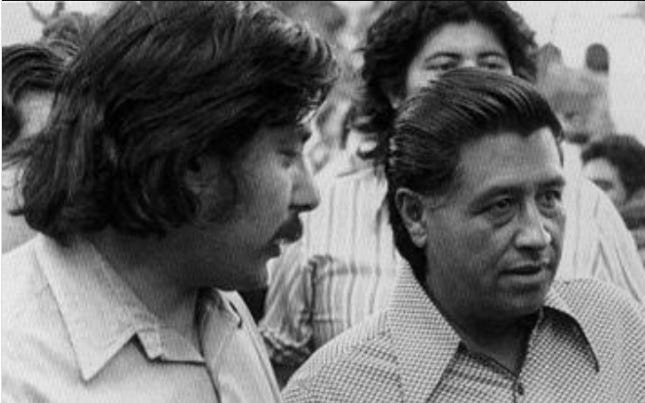
Getting Joe’s legacy into the academic literature is one step toward reclaiming what those students in the archive don’t know. Despite 100 boxes of material and a series of high-profile accomplishments, no one has captured Serna’s secrets to success as mayor—until now.
But tonight isn’t about academic theory. Tonight is about a room at 915 I Street, a 5-3 vote, a mayor who knew how to marshal political capital, and a staff that knew how to turn that capital into deals.
The Kings are still in Sacramento. Arco Arena—the building we refinanced that night—was demolished in 2022. The team now plays in Golden 1 Center, a downtown arena that opened in 2016 after a whole new generation of drama, threats to move to Seattle, and last-minute interventions.
Here’s another twist that still gets me: One of the funding sources for that new downtown arena was revenue from city parking lots. And one of the reasons those parking lots generate significant revenue? The CalEPA headquarters building that Serna fought for in the mid-1990s—bringing thousands of state workers who need places to park.
The building now bears his name: the Joe Serna Jr. Cal/EPA Headquarters Building.
So the mayor who fought to keep the Kings in Sacramento in 1997 also helped create the revenue stream that, two decades later, would help build the arena that replaced the one we saved. He didn’t live to see it—Serna died in 1999—but the infrastructure he built outlasted him.
This is the fourth installment of The Dustbin Historian. For the full academic treatment of Mayor Serna’s governance model—including the archival evidence, the theoretical framework, and the process-tracing methodology—subscribe to follow along. I’ll be sharing more from the paper before and after the Chicago conference in April.