
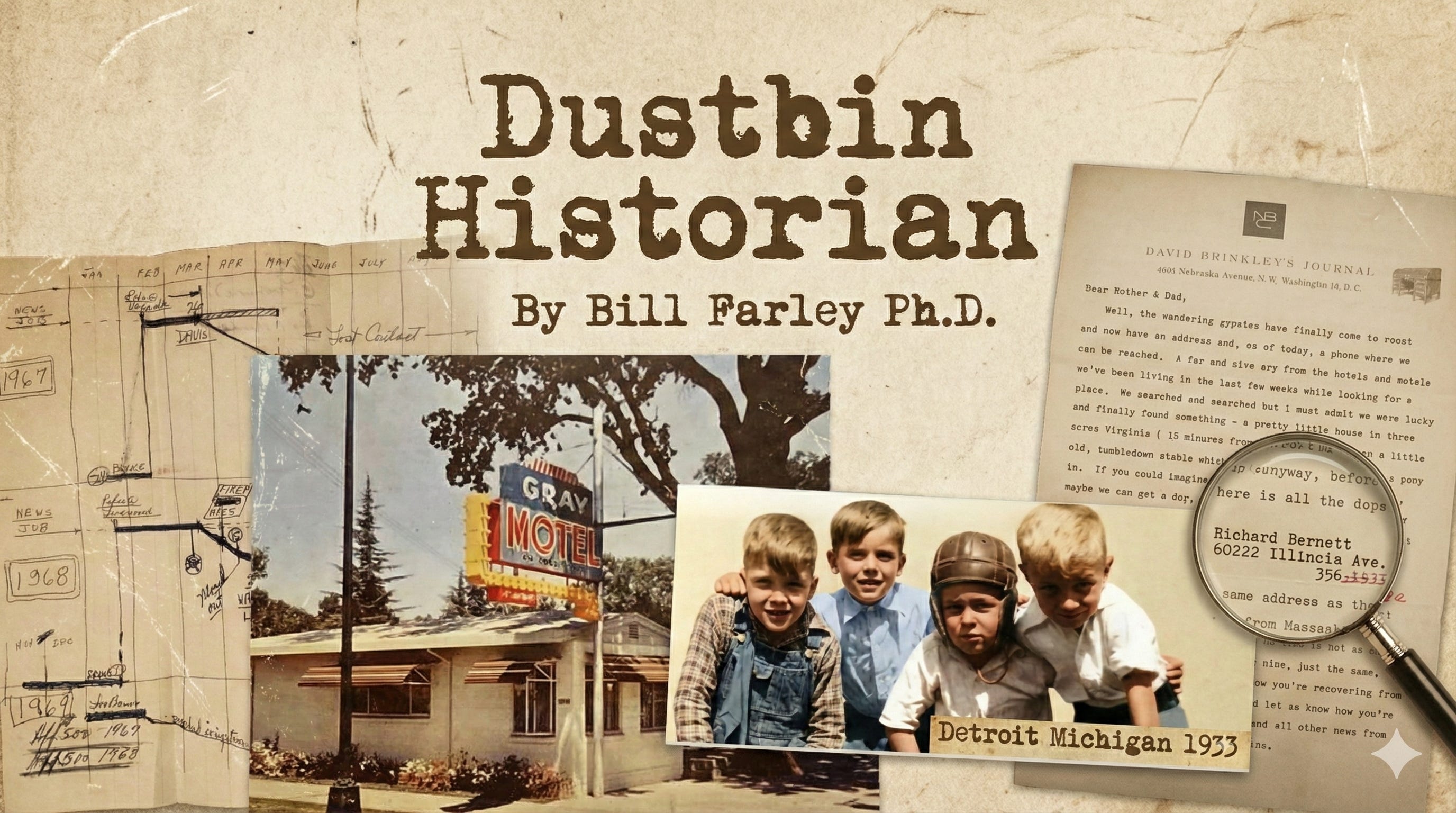
About The Dustbin Historian
I rescue ancestor stories from the dustbin of history—and teach you how to preserve yours before they disappear.
Who I Am
I’m Bill Farley, a published historian and author who helps family researchers transform genealogy data into compelling narratives that get published and preserved.
My work has appeared in American Ancestors (New England Historic Genealogical Society), Montana: The Magazine of Western History, and Wild West. My biography of Montana Copper King James A. Murray was published by Mountain Press with a foreword by noted Irish historian Dave Emmons.
Experts have have recognized my writing for both its academic depth and its narrative power:
“The most enterprising and tireless researcher I’ve met in fifty years.”
—Dave Emmons, author of The Butte Irish
“Great affection for his principal subject, which makes for enjoyable, effortless reading.”
—Aaron Parrett, Montana: The Magazine of Western History
“One of my favorite articles we’ve published in American Ancestors magazine…. Farley made it an uplifting story of strength and perseverance. I came away with great admiration for the people involved.”
—Jean Powers, Senior Editor, American Ancestors Magazine
Before becoming a historian, I spent 30 years conducting due diligence for complex public-private partnerships. After retiring, I turned my attention to the stories gathering dust in family attics, courthouse basements, and fading memories—the stories that exceed what gets naturally remembered.
The Problem I’m Solving
Most family stories vanish within 2-3 generations. Not because they’re unimportant—but because no one does the work to preserve them.
Your grandmother’s parents become names on a family tree. The Civil War veteran who saved a brigade becomes a faded photo in a drawer. The woman who survived immigration, widowhood, and the Depression becomes three sentences in an obituary.
Without systematic research, compelling storytelling, and strategic preservation, these stories disappear completely.
I spent years learning how to prevent that loss—and now I teach others.
What You’ll Find Here
This Substack is where I share rescued stories, research deep-dives, and the methods that transform family history into published work.
You’ll get:
Rescued Stories
Fully researched narratives with artifacts, documents, and photos. Stories like:
My uncle who went from NBC Sports to jail to redemption
My grandmother whose parents she thought were lost to history
The millionaire who funded communist newspapers during WWI
The Civil War soldier whose pension file revealed untold heroism
Each story demonstrates the research process, the narrative techniques, and the preservation strategies that keep ancestor stories alive.
Research Methods That Work
How to find evidence in pension files, probate records, parish registers, and orphanage cards
Which archives to visit and how to maximize your time there
How to organize 200+ sources without losing your mind
How to verify oral history and separate fact from family legend
Tools I use: Ancestry, FamilySearch, Zotero, and specialized databases
Writing & Storytelling Craft
How to turn tragedy into stories of strength and perseverance
Narrative techniques that create admiration, not pity
The “rise-fall-redemption” structure that works for difficult family stories
How to use artifacts as narrative anchors
What editors at American Ancestors taught me about emotional storytelling
Publication Strategies
How to choose which ancestor story is publication-worthy
Where to pitch family history articles (journals, magazines, historical societies)
Query letters that work (and rejection letters that taught me)
Working with editors: the revision process revealed
Alternative preservation when publication doesn’t work (lineage societies, museum donations, digital archives)
Behind-the-Scenes Process
Research trips to courthouses, archives, and historical sites
Dead ends, breakthroughs, and mistakes I made
Costs and time investment (the honest truth)
Correspondence with editors and historians
How I decide which stories to pursue
Free vs. Paid Subscriptions
Free subscribers get:
All rescued stories (full articles)
Research tips and methods
Occasional behind-the-scenes posts
Community discussion in comments
Paid subscribers get everything above, plus:
Complete research files: Full document scans, transcribed letters, archival materials
Extended family context that didn’t make the published story
Editor correspondence and revision drafts (see the publication process in real-time)
Monthly “Research Office Hours” where I answer your specific questions
Early access to new stories before they’re published
Detailed methodology breakdowns: How I found every source, step-by-step
Paid subscription: COMING SOON
All revenue supports continued research, archive visits, and the creation of free resources for the family history community.
My Published Work
Articles:
“I Was Left an Orphan: Reconstructing the Family History of Esther (Rask) Barnett,” American Ancestors (Spring 2014)
“Rocky Mountain Radicals: Copper King James A. Murray, Senator James E. Murray, and Seventy-Eight Years of Montana Politics,” Montana: The Magazine of Western History (Spring 2016)
“Seven Ways to Make a Million in the West: Jim Murray’s Enterprising Schemes in Montana Territory,” Wild West (December 2015)
“Pension Application Reveals New Meaning to Artifacts,” Tennessee Ancestors (Spring 2014)
Book:
James A. Murray: Butte’s Radical Irish Millionaire (Mountain Press, [year])
Foreword by Dave Emmons, author of The Butte Irish: Class and Ethnicity in an American Mining Town
Recognition:
Entry in Dictionary of Irish Biography (Royal Irish Academy) for James A. Murray
Presented at American Conference for Irish Studies (regional chapters)
Featured speaker, Montana Historical Society
Why “Dustbin Historian”?
Historian Dave Emmons wrote that Butte, Montana “produces far more history than the domestic market can absorb.” The excess—the stories that don’t fit in history books—ends up in the dustbin.
The same is true for family history. More stories happen than get preserved. Most end up forgotten, discarded, lost.
I rescue those stories. I teach you how to do the same.
Because every life deserves more than three sentences in an obituary. Every story deserves to be told.
Connect With Me
Watch rescued stories and research methods:
YouTube: The Dustbin Historian
Follow on social media:
X/Twitter: Bill Farley, PhD
Pinterest: DustbinHistorian
Let’s Talk
What family story are you trying to preserve?
Hit reply to any email from this Substack and tell me. I read every response, and your story might inspire a future post about research methods or preservation strategies.
Or leave a comment on any article—I respond to every thoughtful comment and love hearing about the stories you’re rescuing.
Subscribe below to join the community of family historians who refuse to let ancestor stories disappear into the dustbin.
